Understanding what a product does is just as important as understanding what it does not do. These six myths are particularly important for contractors, flooring professionals, architects, facility managers and concrete manufacturers.
Myth 1: A Lithium Silicate Densifier Is Just Another Concrete Sealer
This is probably the most common misunderstanding.
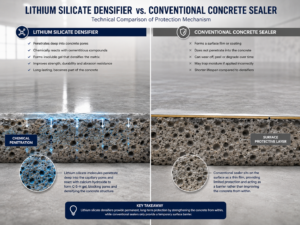
A lithium silicate concrete sealer and a lithium silicate densifier are not necessarily the same thing, even though the terms are sometimes used interchangeably in the market.
A densifier primarily works through a chemical reaction inside the concrete surface. A conventional sealer, depending on its chemistry, may instead form a protective film or create a barrier against water, stains, chemicals or other contaminants.
The two products can therefore serve different purposes.
For example, a polished concrete floor may first require densification to improve surface properties and may then receive another treatment when additional stain, chemical or moisture resistance is required.
Why does this distinction matter?
Because choosing a product based only on the word “sealer” can lead to the wrong expectations.
If your objective is surface densification, hardness and reduced dusting, you need to evaluate a suitable densifier. If the primary objective is stain resistance or creating a specific protective barrier, a compatible sealer may be more appropriate.
The right solution depends on the floor, its condition and the final performance requirements.
Myth 2: Densifiers Repair Cracked or Structurally Damaged Concrete
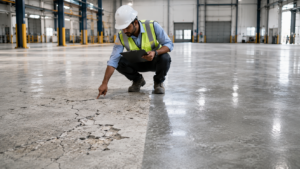
A densifier can improve the characteristics of a suitable concrete surface, but it should not be treated as a structural repair material.
If a floor has:
- Large cracks
- Major spalling
- Delamination
- Structural movement
- Severe surface deterioration
- Deep damage
the underlying issue needs to be assessed and addressed separately.
A densifier works best when the concrete itself is fundamentally sound enough to benefit from surface treatment.
When should you use a densifier?
Ideally, the decision should be made after examining the condition of the concrete and determining what the floor actually needs.
For new construction, the treatment may form part of a planned concrete finishing or polishing system.
For existing floors, surface preparation and condition assessment become even more important.
A professional should not use densification as a substitute for repairing defects that require mechanical or structural intervention.
Myth 3: More Densifier Always Means a Harder Floor
It is easy to assume that applying more product will automatically produce better results.
That is not necessarily true.
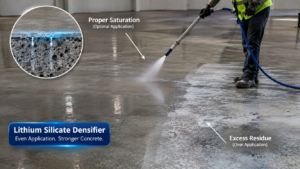
The performance of a lithium silicate treatment depends on several variables, including concrete porosity, surface condition, product concentration, application rate, penetration, environmental conditions and the manufacturer’s recommended procedure.
Concrete is not a sponge with unlimited capacity.
If the surface cannot absorb additional material, applying excessive product can create residue and make the floor more difficult to manage during the finishing process.
How should the correct amount be determined?
The application rate should be based on the specific product and the characteristics of the concrete.
A practical approach is to:
- Evaluate the concrete surface.
- Determine its porosity and condition.
- Follow the manufacturer’s technical recommendations.
- Conduct a small test area where appropriate.
- Observe penetration and surface response.
- Adjust the application method if required.
This is one reason technical guidance matters more than simply following a generic “one-size-fits-all” application rate.
Myth 4: Lithium Silicate Densifiers Automatically Make Every Concrete Floor Glossy
Another common expectation is that applying a lithium silicate densifier will instantly transform a dull concrete floor into a mirror-like surface.
That is not how the process works.
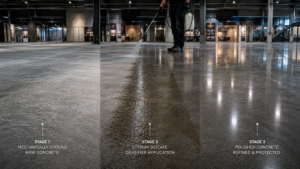
Gloss is strongly influenced by the mechanical polishing process, aggregate exposure, concrete quality, grinding sequence, refinement and finishing technique.
A densifier can support the polishing process by improving the surface characteristics of suitable concrete, but it does not replace mechanical polishing.
Why does polishing matter?
Think of it this way:
Densification improves the material.
Polishing improves the finish.
The final appearance depends on the complete flooring system rather than a single liquid treatment.
A well-designed process can produce a dense, durable and visually attractive floor, but the result depends heavily on the condition and composition of the concrete.
Myth 5: Lithium Silicate Densifiers Are Only for New Concrete
This myth can prevent building owners from considering densification for existing floors.
Lithium silicate treatments can be used in suitable existing concrete applications as well as new flooring projects, provided the surface condition and preparation requirements are appropriate.
Older concrete floors may experience dusting, abrasion and general surface wear. A densification treatment may be considered as part of a broader floor improvement or polishing process.
When is an existing floor a good candidate?
A professional evaluation should consider:
- Existing surface hardness
- Porosity
- Contamination
- Previous coatings or treatments
- Moisture conditions
- Cracks and repairs
- Desired final appearance
- Expected traffic and abrasion
Surface preparation is especially important on older floors because oils, coatings, dirt and other contaminants can interfere with penetration.
So the question should not simply be, “Is this new or old concrete?”
The better question is:
“Is the existing concrete suitable for the treatment and does densification solve a real performance requirement?”
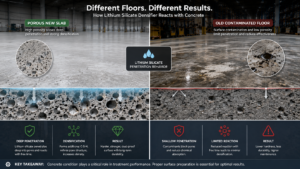
Myth 6: Lithium Silicate Densifiers Work the Same Way on Every Concrete Floor
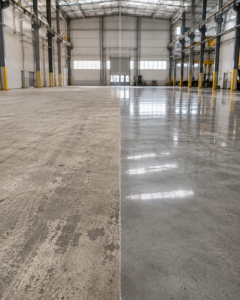
Concrete may look similar from one project to another, but its surface characteristics can vary considerably.
Mix design, age, curing, finishing, porosity, cement content, environmental exposure, previous treatments and mechanical preparation can all influence how a floor responds.
That means the same application approach may not produce identical results everywhere.
Why does concrete condition matter?
Consider two floors:
Floor A:
A relatively new, porous concrete slab prepared for polishing.
Floor B:
An older warehouse floor containing contaminants and areas of previous coating.
They may both appear to be “concrete floors,” but their treatment requirements are very different.
This is why testing and technical assessment can be valuable before large-scale application.
For industrial and commercial projects, the goal should not be simply to apply a product. The goal should be to create a flooring system that performs appropriately for the environment.
How to Choose the Right Lithium Silicate Densifier
Choosing a product should involve more than comparing prices per litre.
Consider the complete application.
1. Understand the concrete
Determine the age, porosity, hardness and current condition of the floor.
2. Define the final objective
Are you trying to reduce dusting? Improve surface hardness? Prepare for polishing? Improve abrasion resistance? Support a specific flooring system?
The answer influences the product selection.
3. Review technical specifications
Look at concentration, application recommendations, compatibility and handling requirements.
4. Consider the application environment
Warehouses, factories, commercial spaces and polished concrete interiors can have very different requirements.
5. Test before full-scale application
Where practical, a test section can help establish how the concrete responds and whether the expected finish is achievable.
6. Work with a technically capable manufacturer
For industrial applications, access to technical support can be just as valuable as the product itself.
Noble Alchem manufactures silicate solutions for different industrial applications and can provide product information based on project requirements.
Why Lithium Silicate Is Commonly Considered for Polished Concrete
Polished concrete is not simply about making concrete look shiny.
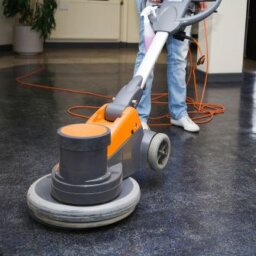
A successful polished floor depends on surface preparation, grinding, densification and progressive refinement.
Lithium-based densification is often considered because lithium silicate solutions can penetrate concrete and participate in the chemical process that contributes to a denser surface.
A suitable densifier can therefore become one part of a larger polishing system.
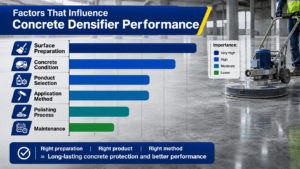
The final result still depends on:
- Concrete quality
- Grinding sequence
- Aggregate characteristics
- Surface preparation
- Densifier selection
- Application technique
- Polishing equipment
- Final refinement
This is why it is better to evaluate the entire process instead of judging a densifier in isolation.
Where Lithium Silicate Densifiers Can Be Useful
Suitable applications can include concrete floors in:
- Warehouses
- Manufacturing facilities
- Distribution centres
- Commercial buildings
- Retail spaces
- Parking areas
- Industrial facilities
- Polished concrete projects
The right application depends on the floor’s condition and the performance requirements of the project.
For example, a busy warehouse may prioritize abrasion resistance and reduced dusting, while a commercial interior may place greater emphasis on surface appearance and ease of maintenance.

A Simple Way to Think About Densification
Imagine a concrete surface with microscopic voids and a relatively open near-surface structure.
A suitable silicate treatment penetrates available pores and reacts with components in the cement paste.
The objective is not to create a thick layer over the concrete.
Instead, the treatment contributes to a denser surface structure.
That is why the term densifier is important.
It describes the intended function more accurately than simply calling the product a coating.
What Should You Believe About Lithium Silicate Densifiers?
Lithium silicate densifiers are useful concrete treatment materials, but they work best when expectations are realistic.
They are not a replacement for structural repairs.
They are not automatically the same as conventional sealers.
They do not make every concrete floor glossy by themselves.
And applying more product does not automatically mean better performance.
The best results come from matching the treatment to the concrete, preparing the surface correctly, following technical application guidance and understanding what the finished floor is expected to do.
For contractors and facility owners, the most useful question is not simply “Which densifier is strongest?”
It is:
“Which treatment is appropriate for this concrete, this application and this performance requirement?”
That shift in thinking can help avoid unnecessary products, unrealistic expectations and costly flooring mistakes.
Noble Alchem focuses on silicate solutions for industrial applications, including lithium silicate products for concrete flooring and finishing applications.
Frequently Asked Questions
1. What does a lithium silicate densifier do to concrete?
A lithium silicate densifier penetrates suitable concrete and reacts with available calcium hydroxide in the cement paste. The reaction contributes to the formation of additional C-S-H, helping create a denser and harder near-surface structure. It can help reduce surface dusting and improve resistance to everyday wear when properly selected and applied.
2. How is a lithium concrete densifier different from a concrete sealer?
A densifier primarily works within the concrete through a chemical reaction, whereas a conventional sealer is generally intended to provide surface protection, depending on its chemistry. A densifier should therefore not automatically be treated as a replacement for every type of concrete sealer.
3. When should a lithium silicate densifier be applied?
It should be applied when the concrete condition, project requirements and manufacturer’s instructions indicate that densification is appropriate. In polished concrete systems, application timing can be connected to the grinding and polishing sequence. Existing floors should generally be evaluated and properly prepared before treatment.
4. Can lithium silicate densifiers be used on old concrete floors?
Yes, suitable existing concrete can potentially benefit from densification. However, the floor should be assessed for contaminants, coatings, cracks, porosity, surface condition and other factors that could affect penetration and performance.
5. Does a lithium silicate densifier make concrete waterproof?
Not automatically. Densification can reduce the openness of the concrete surface, but it should not be assumed to provide the same waterproofing or moisture-barrier function as a dedicated waterproofing system. If waterproofing is the primary requirement, the complete system should be selected for that purpose.