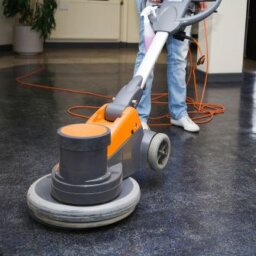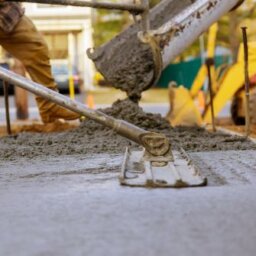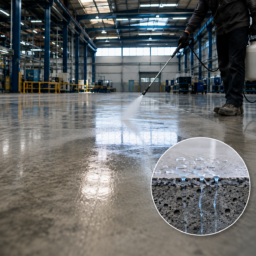
Concrete may look simple, but getting a durable, polished and low-maintenance surface often comes down to what happens beneath the finish.
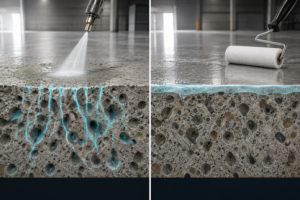
A lithium silicate densifier is designed to penetrate the concrete surface and react with cementitious materials inside the substrate. The resulting reaction helps make the surface harder, denser and more resistant to dusting and abrasion. It is commonly used as part of concrete polishing systems as well as on commercial, industrial and other concrete floors.
Yet many application problems are not caused by the product itself. They happen because the floor was not prepared correctly, the application rate was guessed, excess material was left to dry, or the contractor treated every concrete slab in exactly the same way.
What Is a Lithium Silicate Densifier?
A lithium silicate densifier is a penetrating treatment used to improve the physical characteristics of cementitious surfaces.
Unlike a conventional film-forming coating, a reactive densifier is intended to penetrate the concrete and react within the pore structure. Manufacturer documentation describes lithium-based products as penetrating treatments that react with concrete components and can improve surface hardness, abrasion resistance and polishability.
The exact performance depends on the concrete mix, age, porosity, surface profile, moisture condition and the formulation being used.
That is why applying more product does not automatically mean getting a better floor.
Lithium Silicate Densifier vs. Concrete Sealer: Are They the Same?
Not necessarily.
A densifier primarily works by reacting with the cementitious substrate. A sealer may have a different purpose, formulation and mechanism of protection.
Some products combine densifying, sealing, dustproofing or water- and stain-resistance properties, while others are designed specifically for densification or polishing systems.
Before specifying a product, determine what the floor actually needs:
- Surface hardening
- Dust reduction
- Improved polishability
- Water resistance
- Stain resistance
- A protective top treatment
- A complete polished concrete system
For example, some lithium silicate formulations are explicitly described as non-film-forming treatments rather than conventional coatings.
12 Mistakes to Avoid When Applying Lithium Silicate Densifier
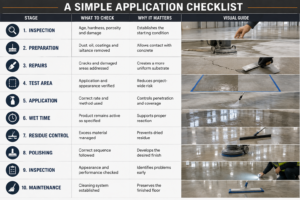
1. Applying the Product Without Proper Surface Preparation
This is one of the easiest mistakes to make and one of the hardest to compensate for later.
Concrete should be clean and suitable for penetration before application. Dirt, oil, grease, curing compounds, laitance, coatings and other contaminants can interfere with the treatment.
Technical guidance for lithium silicate products commonly calls for removing contaminants and repairing cracks or damaged areas before application.
How to avoid it
Before applying the material:
- Remove dust and loose debris.
- Eliminate oil, grease and contaminants.
- Remove incompatible coatings or curing compounds.
- Repair significant cracks, holes and damaged areas.
- Complete the required grinding or surface preparation.
- Vacuum or clean the floor thoroughly.
- Perform a test area before treating the entire floor.
Why it matters
The densifier needs access to the concrete surface and its pore structure. If contaminants are sitting between the product and the concrete, penetration can become inconsistent.
2. Assuming Every Concrete Floor Needs the Same Application Rate
There is no universal application rate that works perfectly on every slab.
A hard, dense, recently ground floor behaves differently from an old, soft or highly porous floor.
Manufacturer guidance notes that coverage can vary according to porosity, age, moisture, absorption, texture and surface condition.
How to avoid it
Assess the floor first.
Look for:
- Open pores
- Absorption
- Surface hardness
- Grinding profile
- Existing treatments
- Age of concrete
- Moisture condition
Then establish the application rate using the product’s TDS and a representative test section.
Why it matters
Using too little material can leave areas untreated. Using too much can create unnecessary residue, waste and cleanup problems.
3. Guessing the Dilution Ratio
Dilution is not something to copy from another product or another project.
Different lithium silicate formulations have different concentrations and instructions. Some products are supplied ready to use, while others may be diluted according to the substrate and application requirements.
For example, Sika’s technical information states that dilution can depend on surface age, hardness, porosity, moisture and intended use.
How to avoid it
Always check:
- Product concentration
- Recommended dilution
- Substrate condition
- Coverage rate
- Ambient conditions
- Manufacturer’s application instructions
Why it matters
Incorrect dilution changes how much active material reaches the concrete and can affect penetration and final performance.
4. Applying It to a Dirty or Non-Absorbent Surface
A floor can appear visually clean and still have contaminants that interfere with penetration.
Old curing compounds, oils, coatings, dust and other residues can create a barrier.
A lithium silicate treatment is not a substitute for removing a surface contaminant.
How to avoid it
Perform a simple absorption assessment in the test area.
If the concrete does not accept the treatment as expected, stop and investigate the surface condition rather than simply applying more product.
Why it matters
The treatment needs contact with the cementitious substrate. A contaminated surface can produce uneven results, particularly when different sections of the floor have different levels of absorption.
5. Flooding the Floor With Excess Material
More is not always better.
One of the common problems during application is allowing excess densifier to remain in puddles.
Sika specifically warns that puddled material allowed to dry can leave unsightly salts that are difficult to remove. Its application instructions also recommend working excess material into the surface rather than allowing it to dry in place.
How to avoid it
Apply enough material to achieve the required coverage and keep the surface appropriately wet according to the product instructions.
If excess material accumulates:
- Spread it into dry or absorbent areas where appropriate.
- Scrub it into the substrate.
- Remove excessive puddling according to the TDS.
- Do not simply leave it to dry.
Why it matters
Controlled application is more important than simply increasing volume.
6. Letting the Product Dry Too Quickly
Penetrating treatments need sufficient contact time to interact with the substrate.
If the material disappears almost immediately, the floor may be highly absorbent—or the application conditions may be causing rapid drying.
Some manufacturer instructions specify keeping the surface wet for a defined period, while others use different application procedures.
How to avoid it
Pay attention to:
- Temperature
- Wind
- Humidity
- Concrete absorption
- Application rate
- Product instructions
On hot or windy projects, the application may need to be managed differently to prevent premature drying.
Why it matters
The goal is controlled penetration and reaction, not simply getting the liquid onto the floor.
7. Ignoring Lap Marks and Uneven Application
Uneven application can become obvious after the floor dries or is polished.
Overlapping wet areas, inconsistent spray patterns and differences in application rate can create visible variations.
Some product instructions specifically warn against creating lap marks because they may become difficult or impossible to remove after drying.
How to avoid it
Divide the floor into manageable sections.
Use:
- Consistent spray patterns
- Controlled application rates
- Proper overlap
- Trained applicators
- Clearly defined work zones
Maintain a wet edge where required by the manufacturer’s application method.
Why it matters
Consistency during application directly influences the uniformity of the finished floor.
8. Skipping the Test Area
A small test area can reveal problems before they become an expensive full-floor problem.
This is particularly important when the slab has different finishes, repairs, levels of porosity or previous treatments.
Manufacturer guidance recommends representative test sections performed by the same workers who will carry out the larger application.
What should the test area tell you?
Use it to evaluate:
- Penetration
- Coverage
- Drying behavior
- Residue
- Polishing response
- Final appearance
- Slip resistance where relevant
- Compatibility with subsequent treatments
Why it matters
A 10-square-meter test area is much easier to correct than a 1,000-square-meter installation.
9. Applying the Densifier at the Wrong Stage of the Polishing Process
Polished concrete is a system, not simply a single product.
Grinding removes imperfections and opens the surface. Densification is then incorporated at an appropriate stage based on the selected polishing system and product.
The correct point can vary according to the floor, grinding sequence and manufacturer’s recommendations.
Some systems, for example, describe application after grinding and before later polishing stages.
How to avoid it
Build the application into the complete polishing specification.
10. Failing to Account for Moisture and Environmental Conditions
The same product can behave differently on two floors because the site conditions are different.
Concrete moisture, temperature, humidity and airflow can influence absorption and drying.
How to avoid it
Before starting, document:
- Ambient temperature
- Relative humidity
- Concrete condition
- Surface moisture
- Ventilation
- Sun exposure
- Wind or airflow for exterior work
If the manufacturer’s TDS gives environmental limits, follow them.
Why it matters
A controlled application environment makes the results more predictable.
- Ignoring Safety and Slip Resistance During Application
A wet concrete treatment can temporarily make the floor slippery.
Application teams also need to consider overspray, splash protection, ventilation and appropriate personal protective equipment.
Manufacturer instructions advise protecting adjacent surfaces and evaluating wet and dry slip resistance where applicable.
How to avoid it
Use:
- Appropriate PPE
- Controlled application equipment
- Barriers and warning signage
- Protection for nearby surfaces
- Adequate ventilation where required
- A documented site safety procedure
Do not reopen the floor simply because it looks dry.
Follow the product’s specified return-to-service requirements.
12. Treating the Finished Floor Without Understanding the Product’s Limitations
A densifier can improve the concrete surface, but it does not magically correct poor concrete.
It will not replace:
- Proper structural repair
- Correct grinding
- Crack repair
- Surface preparation
- Good polishing technique
- Appropriate maintenance
- A compatible protective system
A lithium treatment may improve hardness, dust resistance and polishability, but the exact benefits depend on the formulation and substrate.
How to avoid it
Think of densification as one part of the concrete-floor system.
How to Choose the Right Lithium Silicate Densifier
There is no single product that is automatically the best choice for every concrete floor.
Instead, compare the product against the project.
Look at the Product Chemistry
Check the technical data for:
- Lithium silicate concentration
- Solids content
- VOC information
- pH
- Recommended dilution
- Coverage
- Drying time
- Storage requirements
For example, published technical data for different lithium silicate products shows that formulations and recommended application characteristics can vary considerably.
Consider the Concrete
Ask:
- Is the floor new or old?
- Is it soft or hard?
- Has it already been ground?
- Is it highly absorbent?
- Is there an existing coating?
- Will the floor be polished?
- Is it an interior or exterior application?
These questions are often more useful than simply choosing a product because it has the word “lithium” on the label.
Lithium Concrete Densifier for Polished Concrete
A lithium concrete densifier is frequently incorporated into polished concrete systems because increasing surface hardness can make the substrate more suitable for subsequent polishing.
The important point is that densification should not be treated as an isolated step.
The final result depends on the interaction between the concrete mix, grinding sequence, densifier application, polishing equipment, diamond tooling and maintenance program.
For a professional installation, the complete system should be tested before full-scale production.
When Should You Apply a Lithium Silicate Treatment?
The correct timing depends on the specific product and concrete system.
Some manufacturer instructions require the concrete to have reached a certain cure stage, while others are designed for different stages of construction or polishing. Sika, for example, states that its Formula One lithium densifier requires concrete to be at least seven days old, with 28 days preferred for a fully cured and absorbent slab. Other technical data sheets specify different substrate requirements.
So the better question is not simply:
“When should I apply a densifier?”
It is:
“At what stage does this specific densifier perform best on this specific concrete surface?”
That answer should come from the product TDS, project specification and test section.
Why Lithium Silicate Is Used on Concrete Floors
When properly selected and applied, lithium silicate treatments can provide several practical benefits.
1. Harder Surface
The chemical reaction within the cementitious substrate can improve surface hardness.
2. Reduced Dusting
Densification can help reduce loose surface dust associated with porous or weak concrete.
3. Improved Abrasion Resistance
A harder surface can be better suited to demanding commercial and industrial environments.
4. Easier Polishing
Some products are specifically formulated to improve the polishing process and help develop the desired finish.
5. Low-Maintenance Surface
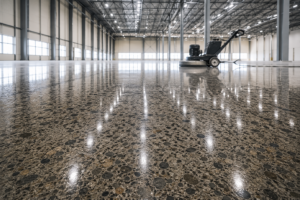
Densified and polished concrete can be easier to maintain when the complete flooring system is correctly designed.
Lithium Silicate Densifier vs. Lithium Silicate Concrete Sealer
These terms are sometimes used interchangeably in the market, but they should not automatically be treated as identical.
A densifier is generally focused on reacting with and improving the cementitious substrate.
A sealer may provide additional protection against water, stains or other contaminants.
Some modern products combine these functions. For example, lithium silicate products are available that are specifically formulated to add water- and stain-resistance properties to already densified or polished concrete.
The practical question
Before buying or specifying a product, identify the performance requirement.
If your objective is primarily:
- Hardening → evaluate densification performance.
- Dustproofing → evaluate dust-control performance.
- Polishing → evaluate compatibility with the polishing system.
- Stain protection → consider a compatible protective treatment.
- Water resistance → evaluate the product’s water-repellent properties.
This avoids expecting one treatment to perform every function.
How to Get More Consistent Results on Large Projects
Large floors introduce another challenge: consistency.
A product may work perfectly in a small test area but produce variation across a warehouse or commercial building if application teams change their technique.
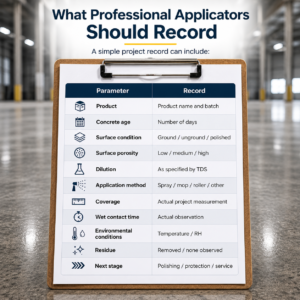
For large projects, document:
- Product batch
- Mixing/dilution procedure
- Application equipment
- Application rate
- Coverage achieved
- Ambient conditions
- Concrete condition
- Start and finish times
- Number of coats
- Polishing stage
- Cleaning procedure
This creates a repeatable process rather than relying on individual operator judgment.
What Professional Applicators Should Record
Frequently Asked Questions
1. What does a lithium silicate densifier do to concrete?
A lithium silicate densifier penetrates the concrete surface and reacts with cementitious components within the substrate. Depending on the product and concrete condition, this can increase surface hardness, reduce dusting and improve abrasion resistance. Some formulations are also designed to support polishing or add water and stain resistance.
The result is not simply a layer sitting on top of the concrete. Many lithium silicate products are designed as penetrating, non-film-forming treatments.
2. How long should lithium silicate densifier remain wet on concrete?
There is no universal wet-contact time.
The correct period depends on the specific product, concrete porosity, application rate and environmental conditions.
For example, one Sika product specifies keeping the surface wet for approximately 5–10 minutes during its application process, while other products provide different instructions.
Always follow the TDS for the exact material being used.
3. Can lithium silicate densifier be used on polished concrete?
Yes, depending on the product and polishing system.
Lithium silicate treatments are commonly used as part of polished concrete systems. They can be applied at an appropriate stage in the grinding and polishing process to improve the hardness and polishing characteristics of the cementitious surface.
However, the correct application stage should be established from the manufacturer’s instructions and confirmed with a test section.
4. Can I apply too much densifier?
Yes.
Excess application can create puddles or leave residue that becomes difficult to remove after drying. Sika specifically cautions against allowing excess material to dry in puddles because it can form unsightly salts.
The goal is controlled application and adequate penetration not maximum product consumption.
5. Is a lithium silicate densifier the same as a concrete sealer?
Not always.
Some products are primarily densifiers, while others combine densification with sealing, water resistance or stain resistance.
Before selecting a product, check its technical data sheet and identify the performance characteristics required for your floor. A densifier should not automatically be expected to provide every type of surface protection.