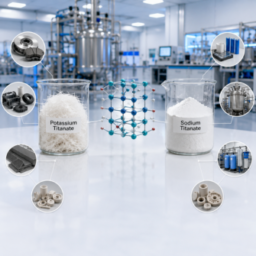
Ceramic manufacturing is no longer limited to choosing a clay body, adding a binder and firing the finished component. Modern ceramic products are expected to deliver specific combinations of thermal stability, mechanical performance, dimensional control, electrical behavior and resistance to demanding operating conditions.
That is where carefully selected functional materials can make a significant difference.
Sodium titanate is one such material. Depending on its composition, structure, particle characteristics and processing conditions, sodium-titanate-based materials can contribute to specialized ceramic formulations and advanced functional ceramics.
For ceramic manufacturers, the important question is not simply what sodium titanate is. The more useful questions are:
How is it used? When does it make sense to introduce it into a ceramic formulation? And why would a manufacturer choose it instead of another titanium-containing additive?
This guide explores those questions through nine practical areas of application while also looking at material selection, processing considerations and quality control.
What Is Sodium Titanate?
Sodium titanate refers to a family of sodium–titanium–oxygen compounds rather than one single material with only one possible structure.
Depending on the chemistry and processing route, sodium titanates can occur in different phases and structures. Research on sodium-titanate ceramic systems has shown that their structural and microstructural characteristics can influence properties such as electrical resistivity and other functional behavior.
For industrial users, this distinction matters.
A ceramic producer should not select a material solely because it is labelled “sodium titanate.” The actual grade, chemical composition, particle size, morphology, purity and compatibility with the rest of the formulation can determine whether it performs as expected.
This is particularly important in technical ceramics, where relatively small formulation changes can influence firing behavior, shrinkage, porosity, mechanical properties and electrical characteristics.
9 Uses of Sodium Titanate in Ceramic Manufacturing
Sodium titanate can have different roles depending on the ceramic system and the desired end performance. The following nine applications represent practical areas where sodium-titanate-based materials can be relevant.
1. Functional Ceramic Formulations
One of the most important uses is as a functional component in specialized ceramic compositions.
Unlike conventional ceramic raw materials that are mainly selected for forming, firing or structural purposes, functional additives are introduced to influence a particular property.
Sodium-titanate-based phases can be investigated in ceramic systems where electrical, dielectric, thermal or structural characteristics need to be controlled.
Why is this useful?
The value comes from the ability to modify the ceramic’s microstructure and phase composition.
During firing, the interaction between sodium titanate and other ingredients can influence the phases that develop in the final body. The result depends heavily on formulation and processing conditions, so laboratory testing is essential before moving to commercial production.
When should manufacturers consider it?
It is particularly relevant when a conventional ceramic formulation cannot deliver the required functional characteristics and a titanium-containing modification is being evaluated.

2. Advanced Technical Ceramics
Technical ceramics are designed around performance rather than appearance alone.
They may need to withstand thermal cycling, mechanical stress, electrical loads or chemically demanding environments. In these systems, material selection becomes considerably more precise than in conventional ceramic production.
Sodium-titanate-containing systems can be explored for specialized ceramic compositions where controlled phase development and functional properties are important.
The key point is that the material should be treated as part of an engineered formulation rather than as a universal performance enhancer.
How does it contribute?
Its effect depends on:
- Chemical composition
- Crystal structure
- Particle size
- Dispersion
- Firing temperature
- Holding time
- Atmosphere
- Interaction with other ceramic constituents
A technically sound formulation therefore starts with the target property and works backward toward material selection.

3. Electrical and Dielectric Ceramic Research
Some sodium-titanate-based ceramic systems have attracted research interest because their electrical behavior can be modified through phase composition and microstructure.
Research on sodium-titanate ceramic systems has demonstrated that electrical resistivity can depend on the resulting structure and microstructure as well as the sintering method.
This creates potential relevance for specialized electrical and dielectric ceramic development.
Why does microstructure matter?
During sintering, particles react, densify and form new phases. Grain boundaries, porosity and phase distribution can all influence how electrical properties develop.
For manufacturers, this means that simply adding a fixed percentage of a material may not deliver a predictable result.
The same nominal composition can behave differently if particle size, mixing quality or firing conditions change.
Practical consideration
Before industrial production, manufacturers should establish:
- Target electrical property
- Required density
- Suitable particle size
- Mixing method
- Firing profile
- Acceptable phase composition
- Final testing criteria

4. Ceramic Insulation Components
Ceramic insulation systems often need to balance thermal stability with electrical insulation and dimensional reliability.
Specialized titanate-containing formulations can be evaluated when manufacturers require controlled functional characteristics rather than relying only on traditional ceramic fillers.
Why are ceramic materials useful for insulation?
Ceramics naturally offer several advantages in demanding environments, including high-temperature capability and electrical insulating behavior in many compositions.
The exact performance, however, depends on the ceramic chemistry.
Sodium titanate may therefore be considered as one component within a broader formulation strategy for specialized insulation products.

5. High-Temperature Ceramic Applications
Temperature changes can expose weaknesses in ceramic products.
Repeated heating and cooling can cause expansion, contraction, phase changes or mechanical stress. In applications where high temperatures are involved, manufacturers need to understand not only the melting behavior of individual ingredients but also how the complete ceramic system behaves during firing and service.
Titanium-containing ceramic phases can be relevant to formulations designed for demanding thermal environments.
How should the material be evaluated?
Rather than judging a material only by its nominal temperature resistance, manufacturers should evaluate:
- Thermal expansion
- Phase stability
- Shrinkage
- Thermal cycling
- Mechanical strength after firing
- Interaction with other ingredients
This gives a much more realistic picture of whether the formulation is suitable for the intended application.
6. Ceramic Pigments and Colour-Related Formulations
Titanium-containing compounds are also relevant to ceramic colour and surface technologies.
In ceramic manufacturing, colour development is affected by much more than the pigment itself. Firing atmosphere, temperature, glaze chemistry, particle size and interactions between raw materials can all influence the final appearance.
Titanium-containing materials can therefore play a role in specific ceramic colour systems and decorative formulations.
Why is formulation control important?
A colour that looks correct before firing may change considerably after firing.
This is why industrial ceramic producers normally evaluate:
- Raw material purity
- Particle distribution
- Firing temperature
- Furnace atmosphere
- Glaze composition
- Surface finish
- Final colour consistency
For large-scale production, repeatability is just as important as the initial shade.

7. Ceramic Coatings and Surface Engineering
Surface coatings are often used when the underlying ceramic requires additional functional or protective characteristics.
Titanium-containing compounds can be considered in specialized coating formulations where thermal, chemical, surface or optical properties need to be adjusted.
When are these formulations useful?
They may be relevant when the manufacturer needs a surface to behave differently from the bulk ceramic.
For example, a coating may be engineered to influence:
- Surface hardness
- Thermal behavior
- Chemical resistance
- Surface appearance
- Adhesion
- Functional response
The final result depends on coating thickness, particle dispersion, substrate compatibility and firing conditions.
8. Catalyst and Functional Ceramic Supports
Some advanced ceramic systems are developed not simply as structural materials but as functional supports.
Their porosity, surface chemistry, thermal stability and phase composition can be engineered for specialized applications.
Sodium-titanate-based materials can therefore be relevant to research and development involving functional ceramic structures and support materials.
Why is surface structure important?
A ceramic with carefully controlled surface characteristics can behave very differently from a dense ceramic body.
Factors such as:
- Surface area
- Porosity
- Pore size
- Phase composition
- Particle morphology
can influence how the material interacts with its surrounding environment.
For manufacturers, this means that particle and processing specifications should be considered together rather than independently.

9. Research and Development of Next-Generation Ceramics
Perhaps the most important application is not one finished product but the development of new ceramic systems.
Materials research continues to explore sodium-titanate-based ceramics for electrical and functional properties. Published research has specifically examined sodium-titanate systems produced through conventional and laser sintering, showing how processing can affect structure and electrical resistivity.
This demonstrates an important principle:
Material chemistry and manufacturing process cannot be separated.
A ceramic formulation that performs well in laboratory conditions may require further optimization before it becomes suitable for high-volume manufacturing.
For this reason, R&D teams often evaluate several grades and processing conditions rather than selecting a material based on chemical name alone.

How Does Sodium Titanate Influence Ceramic Processing?
Understanding the application is only half of the equation.
The other half is understanding what happens during processing.
Ceramic manufacturing generally involves stages such as raw material preparation, weighing, mixing, forming, drying, firing and finishing. Each stage can influence the final behavior of a titanate-containing formulation.
1. Raw Material Preparation
Particle size and purity should be controlled before mixing.
Variations in particle characteristics can affect dispersion and the reaction between ingredients during firing.
2. Mixing
Uniform dispersion is essential.
Poor mixing can produce localized concentrations of one component, creating inconsistent phase development and potentially causing variation between finished parts.
3. Forming
The forming method influences green density and the distribution of particles.
Pressing, extrusion, casting and other forming processes can produce different starting structures.
4. Drying
Moisture removal needs to be controlled to reduce cracking, distortion or uneven drying.
5. Sintering
This is often the most critical stage.
Temperature, heating rate, atmosphere and holding time can affect phase formation, grain growth and density.
6. Final Testing
The finished ceramic should be tested against the property that matters for the application.
This may include:
- Density
- Porosity
- Mechanical strength
- Thermal behavior
- Electrical properties
- Chemical resistance
- Dimensional stability
- Phase composition
How, When and Why Should Manufacturers Choose This Material?
Material selection becomes easier when these three questions are asked before procurement.
How should it be selected?
Start with the finished ceramic’s required properties.
Instead of asking, “Which grade is available?”, ask:
What does the final ceramic need to achieve?
Then work backward through formulation, particle characteristics and processing requirements.
Why does supplier quality matter?
Consistency matters because ceramic manufacturing is highly sensitive to raw-material variation.
A difference in chemical composition, particle size or morphology can change processing behavior and final performance.
Noble Alchem states that its titanate products are manufactured with modern testing equipment including XRF, PSA, SEM, XRD and surface-area analysis, with products developed according to customer specifications.
Where Does Sodium Titanate Fit in the Ceramic Value Chain?
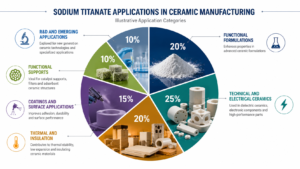
A second useful visual is a pie chart showing the types of activities discussed in this article, rather than pretending to represent actual market percentages.
Quality Control: What Ceramic Manufacturers Should Check
A technically suitable material can still create problems if quality varies from batch to batch.
For this reason, manufacturers should establish incoming-material specifications before large-scale procurement.
Important parameters may include:
Chemical Composition
Confirm that the material meets the agreed chemical specification.
Particle Size
Particle-size distribution can influence mixing, dispersion, reaction and sintering behavior.
Morphology
Particle shape and structure can affect packing and processing.
Moisture
Moisture variation can influence weighing, mixing and storage stability.
Phase Composition
Where the application depends on a particular crystalline phase, phase identification becomes particularly important.
Batch-to-Batch Consistency
The same formulation should behave consistently from one production batch to the next.
Noble Alchem describes quality control beginning at the raw-material stage and reports the use of analytical equipment including XRF, PSA and SEM as part of its quality-control approach.
Frequently Asked Questions
1. What is sodium titanate used for in ceramic manufacturing?
It can be used in specialized ceramic formulations where manufacturers want to investigate or control functional, electrical, thermal or structural characteristics. Its usefulness depends on the specific sodium-titanate phase, grade, particle characteristics and the other ingredients in the ceramic formulation.
It should therefore be considered a formulation-specific material rather than a universal ceramic additive.
2. How does sodium titanate affect ceramic properties?
Its effect depends on the ceramic system and processing conditions.
During firing, interactions between sodium titanate and other raw materials can influence phase formation and microstructure. These changes may affect electrical behavior, density, thermal characteristics and other final properties.
Because the outcome is formulation-dependent, laboratory trials and controlled firing studies are recommended before commercial-scale use.
3. When should manufacturers use sodium titanate in a ceramic formulation?
It should generally be considered during the formulation-development stage when a particular performance requirement has been identified.
For example, an R&D team may investigate it when developing specialized electrical, functional or advanced ceramic systems.
The material should be evaluated alongside particle size, chemical composition, firing temperature, atmosphere and compatibility with the other raw materials.
4. Why is particle size important when selecting sodium titanate?
Particle size affects how the material disperses and interacts with other ingredients.
A well-controlled particle-size distribution can support more consistent mixing and processing, while uncontrolled variation may contribute to differences in packing, reaction behavior and final microstructure.
For industrial ceramic production, particle-size specifications should therefore be agreed according to the intended application rather than treated as a secondary detail.
5. How can manufacturers ensure consistent results when using sodium titanate?
Consistency starts with consistent raw material.
Manufacturers should define specifications for chemical composition, particle size, moisture, morphology and, where relevant, crystalline phase. Incoming-material testing should then be combined with controlled mixing, forming and firing conditions.
Supplier quality systems are also important. Noble Alchem reports using analytical techniques including XRF, PSA, SEM and XRD to support quality control and customer-specific product requirements.