Yes, and here’s why. If you manage a warehouse, factory, parking structure, or any heavy-use industrial floor, a lithium silicate densifier is one of the smartest long-term investments you can make. It strengthens concrete from the inside, eliminates dust, and cuts your floor maintenance costs significantly over time. Noble Alchem, a leading manufacturer and supplier of lithium silicate densifiers in India, breaks down everything you need to know.
What Is a Lithium Silicate Densifier?
Lithium silicate densifier is a water-based chemical solution applied directly to concrete floors. It reacts with the calcium hydroxide naturally present in concrete to form calcium silicate hydrate (CSH) — the same compound that gives concrete its strength.
In simple terms, it fills the tiny pores and gaps inside concrete, making the surface harder, denser, and more resistant to wear and contamination.
It is used across industrial and commercial settings, including:
- Manufacturing plants and heavy-duty warehouses
- Logistics and distribution centers
- Parking structures and vehicle bays
- Food processing facilities
- Retail floors and showrooms
How Does It Work Inside Concrete?
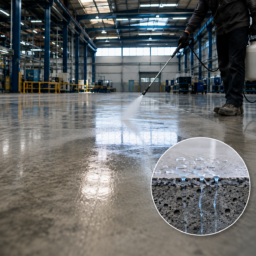
When you apply Noble Alchem’s lithium silicate densifier to a concrete surface, it penetrates deep into the slab rather than sitting on top like a coating. The active lithium silicate molecules react chemically with free lime in the concrete, forming a hard crystalline structure throughout the floor.
This is what makes it fundamentally different from surface sealers or coatings that peel, chip, or wear off over time. The densification happens within the concrete itself — permanently.
The result: a harder surface that resists abrasion, repels dust, and no longer needs frequent recoating.
Key Benefits for Industrial Floors
1. Significant Increase in Surface Hardness
Lithium silicate densification can increase the compressive strength and surface hardness of concrete by up to 35–45%. For floors that carry forklifts, heavy machinery, or constant foot traffic, this is a major operational advantage.
2. Dust-Proofing and Improved Hygiene
Untreated concrete constantly sheds fine particles — known as dusting. This is a serious concern in food-grade facilities, pharmaceutical units, and electronics warehouses. Lithium silicate densifiers effectively eliminate dusting by sealing the pores that generate it, reducing airborne concrete dust by over 80%.
3. Extended Floor Lifespan
Untreated industrial concrete floors typically need significant repair or resurfacing every 5–8 years under heavy use. A properly densified floor can extend the serviceable lifespan to 15–20 years or more, depending on traffic conditions. That’s a 2–3x improvement in floor longevity.
4. Lower Maintenance Costs
Because the surface is sealed, stains, oils, chemicals, and moisture do not penetrate as easily. Routine cleaning becomes faster and cheaper. Studies in industrial flooring show that densified floors can reduce annual maintenance costs by 40–60% compared to untreated concrete.
5. No Downtime for Reapplication
Unlike paint coatings or epoxy that need periodic stripping and reapplication, a chemically densified floor does not need retreatment. Once applied, it’s permanent — a major advantage for facilities that cannot afford downtime.
Lithium vs. Sodium vs. Potassium Silicate Densifier — What’s the Difference?
The performance chart above shows how lithium silicate outperforms sodium and potassium silicate across the four most important parameters for industrial floors. Here’s why those differences matter in practice:
| Feature | Lithium Silicate | Sodium Silicate | Potassium Silicate |
| Particle size | Smallest — deepest penetration | Larger — surface-level reaction | Medium |
| Efflorescence risk | Very low | High — leaves white residue | Medium |
| Application speed | Fast, no waiting | Slower cure | Medium |
| Effectiveness on aged concrete | Excellent | Limited | Moderate |
| Long-term durability | Highest | Lower | Moderate |
| Cost | Moderate–high | Low | Low–moderate |
| Best for | Industrial, food-grade, heavy-use | Light residential | Commercial light use |
The key reason lithium silicate wins is particle size. Lithium particles are significantly smaller than sodium or potassium variants, which means they penetrate deeper into the concrete matrix and react more completely. The result is a more thorough and lasting densification — with minimal risk of the chalky white efflorescence commonly seen with sodium silicate applications.
Is the Cost Worth It? (ROI Perspective)
Let’s look at a realistic scenario for a 5,000 sq. ft. warehouse floor:
A one-time application of Noble Alchem’s lithium silicate densifier adds a relatively modest upfront cost compared to epoxy or polyurethane coatings, which typically require reapplication every 3–5 years, along with floor grinding preparation costs.
Over 10 years, a densified floor can:
- Save 40–60% on annual cleaning and maintenance
- Eliminate 2–3 recoating cycles for epoxy (each cycle costing ₹30–60 per sq. ft. in labour and material)
- Reduce unplanned repair costs caused by surface spalling or dusting-related contamination
- Avoid operational downtime linked to floor resurfacing projects
The total cost saving over a decade for a 5,000 sq. ft. industrial floor can easily exceed ₹3–5 lakhs when maintenance, repairs, and downtime costs are factored together.
That makes lithium silicate densifier one of the highest-ROI treatments in industrial flooring.
Real-World Use Cases Where Noble Alchem Has Made a Difference
Across industries, Noble Alchem’s lithium silicate densifiers have delivered measurable results:
Warehouses and logistics hubs use it to handle constant forklift traffic without floor degradation. Forklift wheel marks and surface erosion are dramatically reduced.
Food processing facilities rely on it for hygiene compliance — a dust-free, non-porous floor is essential in regulated environments.
Auto parking structures benefit from the chemical resistance to oils, fuel spills, and de-icing agents that would otherwise degrade untreated concrete rapidly.
Manufacturing plants use it to reduce cleaning frequency on production floors where hygiene and operational efficiency go hand in hand.
Why Choose Noble Alchem for Lithium Silicate Densifier?
Noble Alchem is a trusted manufacturer and supplier of high-performance lithium silicate densifiers for industrial applications across India. Our formulations are:
- Engineered for deep penetration into Indian climatic conditions
- Tested across high-traffic and chemically aggressive environments
- Available in customized concentrations for new and aged concrete
- Supported by technical guidance and on-site consultation
We don’t just sell a product — we help you choose the right formulation, apply it correctly, and get the maximum life out of your floor.
Consult Noble Alchem for industrial flooring solutions tailored to your facility’s specific requirements. Explore our lithium concrete densifier product range to find the right grade for your project.
Frequently Asked Questions
- What is a lithium silicate densifier used for?
Lithium silicate densifier is used to harden, dust-proof, and strengthen concrete floors. It is commonly applied in warehouses, factories, parking areas, and food processing facilities to extend floor life and reduce maintenance costs.
- How long does a lithium silicate densifier last?
When applied correctly, the effects are permanent. Lithium silicate chemically bonds within the concrete matrix, unlike coatings that wear off. Treated floors can last 15–20 years under heavy industrial use.
- Is lithium silicate better than sodium silicate densifier?
Yes, for most industrial applications. Lithium silicate has a smaller particle size, penetrates deeper, causes less efflorescence, and delivers more durable hardening. Sodium silicate is cheaper but less effective, especially on older or denser concrete.
- Can a lithium silicate densifier be applied to old concrete?
Yes. In fact, Noble Alchem’s lithium silicate densifiers are specifically formulated to work on both new and aged concrete floors. It is effective even on concrete that has already started to show dusting or surface wear.
- How much does it cost to densify an industrial floor with lithium silicate?
The cost varies based on floor area, concrete condition, and the concentration of densifier used. Noble Alchem offers project-specific pricing. In most cases, the upfront cost is far lower than epoxy or polyurethane coating systems and offers a much better long-term ROI.
- Is lithium silicate densifier safe for food processing floors?
Yes. Once cured, lithium silicate densifiers are non-toxic and do not off-gas. They create a hygienic, low-dusting surface that meets the cleanliness standards required in food production and pharmaceutical environments.
- How is Noble Alchem’s lithium silicate densifier applied? \
It is applied as a liquid onto clean, prepared concrete using a sprayer or roller. The product is spread evenly and allowed to react and absorb. Noble Alchem provides technical guidance on surface preparation, application rates, and curing time for best results.