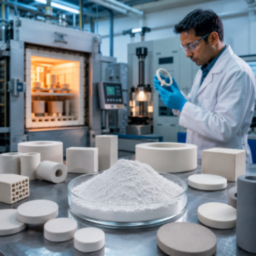
What Every Industrial Buyer Should Know
As industries continue to demand stronger, lighter, and more durable materials, titanate compounds have become an important part of modern manufacturing. From automotive friction materials to advanced ceramics, specialty coatings, and emerging energy technologies, these compounds are helping manufacturers improve product performance while maintaining long-term reliability.
Among the most widely used materials are Potassium Titanate and Sodium Titanate. Although they belong to the same titanate family, their properties, applications, and performance differ significantly. Choosing the wrong material can affect product quality, manufacturing efficiency, and overall production cost.
As one of the trusted Potassium Titanate Manufacturers, Noble Alchem supplies high-quality titanate materials designed to meet the evolving requirements of automotive, ceramic, specialty chemical, and industrial manufacturers worldwide. This guide explains the differences between these two materials, helping engineers, procurement teams, and manufacturers make informed decisions.
What Are Titanate Compounds?
Titanates are inorganic compounds formed by combining titanium with alkali metals. They are valued for their excellent thermal stability, chemical resistance, mechanical strength, and durability under demanding industrial conditions.
Their unique crystal structures make them suitable for applications where conventional fillers or reinforcement materials cannot provide the required performance. Depending on the metal used during synthesis, each titanate exhibits distinct characteristics that influence its industrial use.
Potassium Titanate: Engineered for Strength and Friction Performance
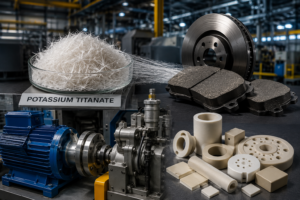
Potassium Titanate is widely used as a reinforcement material in applications requiring high mechanical strength, wear resistance, and thermal stability. Its fibrous structure improves dimensional stability while reducing component wear, making it a preferred choice for demanding engineering applications.
Common Applications
- Automotive brake pads
- Clutch facings
- Engineering plastics
- Industrial friction materials
- High-temperature coatings
- Advanced ceramic products
Key Advantages
- Excellent wear resistance
- High thermal stability
- Low thermal expansion
- Improved mechanical reinforcement
- Longer service life
- Better dimensional stability
These characteristics make Potassium Titanate particularly valuable in industries where components operate under continuous heat and friction.
Sodium Titanate: Designed for Chemical Performance
Unlike Potassium Titanate, Sodium Titanate is primarily recognized for its ion-exchange capability, chemical stability, and adsorption properties. These characteristics have made it increasingly important in environmental engineering, catalyst support systems, and advanced material research.
Growing interest in sustainable manufacturing and energy storage technologies has also increased research into Sodium Titanate-based materials.
Common Applications
- Water treatment systems
- Catalyst support materials
- Specialty ceramics
- Chemical processing
- Research and energy storage applications
Key Advantages
- High chemical stability
- Excellent ion-exchange capability
- Strong adsorption performance
- Good thermal resistance
- Suitable for chemically demanding environments
Understanding the Differences Between Potassium Titanate and Sodium Titanate
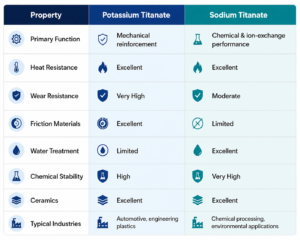
Although both compounds belong to the titanate family, their industrial roles are quite different.
For manufacturers, the choice depends entirely on the intended application. Products exposed to friction and mechanical stress generally benefit from Potassium Titanate, while chemically demanding applications often require Sodium Titanate.
Why Material Selection Matters
Selecting the appropriate titanate compound is more than a technical decision—it directly impacts production efficiency, product reliability, maintenance costs, and customer satisfaction.
Manufacturers should evaluate factors such as:
- Operating temperature
- Mechanical load
- Chemical exposure
- Product lifespan
- Regulatory requirements
- Processing compatibility
Working with an experienced supplier ensures consistent quality, technical guidance, and reliable product performance.
Why Choose Noble Alchem?
Noble Alchem focuses on delivering advanced inorganic materials that meet stringent industrial quality standards. With a commitment to consistency, innovation, and customer support, the company serves manufacturers across multiple sectors with reliable material solutions.
Customers benefit from:
- Consistent product quality
- Advanced manufacturing processes
- Technical assistance
- Reliable global supply
- Industry-focused expertise
- Customized material solutions
Whether developing next-generation industrial products or improving existing manufacturing processes, Noble Alchem helps businesses achieve dependable results.
Conclusion
Understanding the differences between Potassium Titanate and Sodium Titanate enables manufacturers to choose materials that align with their technical and commercial objectives. While Potassium Titanate delivers exceptional reinforcement, wear resistance, and friction performance, Sodium Titanate offers superior chemical stability and ion-exchange characteristics for specialized applications.
By partnering with experienced Potassium Titanate Manufacturers like Noble Alchem, businesses gain access to high-quality materials backed by technical expertise and dependable supply, ensuring better product performance and long-term manufacturing success.
Frequently Asked Question
1. What is the primary difference between Potassium Titanate and Sodium Titanate?
Potassium Titanate is mainly used for mechanical reinforcement and friction applications, whereas Sodium Titanate is preferred for chemical processing, adsorption, and ion-exchange applications.
2. Which industries commonly use Potassium Titanate?
Automotive, engineering plastics, industrial friction materials, advanced ceramics, coatings, and specialty manufacturing are among the major users.
3. Is Sodium Titanate suitable for water treatment applications?
Yes. Due to its excellent adsorption and ion-exchange characteristics, Sodium Titanate is used in specialized environmental and water treatment processes.
4. How do I choose the right titanate material?
The selection depends on operating conditions, required mechanical properties, chemical exposure, processing methods, and end-use performance. Consulting a technical material supplier like Noble Alchem helps ensure the right choice.
5. Why should manufacturers work with Noble Alchem?
Noble Alchem combines technical expertise, consistent product quality, dependable supply, and customer-focused support to deliver advanced titanate materials that meet industrial performance requirements.