
The demand for advanced materials is growing as industries explore more efficient energy storage, sustainable chemical processing, and innovative environmental solutions. Among the materials receiving increasing scientific attention, sodium titanate is emerging as an important material family with potential applications in electrochemistry, ion exchange, and specialised industrial processes.
Sodium titanate consists of compounds containing sodium, titanium, and oxygen. Its properties vary according to its composition, crystal structure, and method of preparation. Certain forms can accommodate sodium ions during battery operation, while others are investigated for ion exchange and the removal of selected contaminants from aqueous solutions.
Recent research is exploring ways to improve sodium titanate through nanostructuring, surface modification, carbon-based composites, and controlled material synthesis. These developments may expand its usefulness in applications where conventional materials face performance limitations. Research published in Energy Advances in February 2026 highlights several strategies for improving sodium titanate anodes for sodium-ion batteries.
What Is Sodium Titanate?
Sodium titanate is an inorganic material family composed primarily of sodium, titanium, and oxygen. Different compositions have different structural characteristics, which influence their chemical behaviour and suitability for industrial applications.
One extensively studied composition is sodium trititanate, represented by the chemical formula Na₂Ti₃O₇. Its layered structure makes it interesting for sodium-ion storage research. Other sodium titanate compositions have different structures and may exhibit different electrochemical or chemical properties.
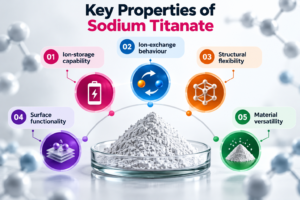
Important characteristics of selected sodium titanate materials include:
- Ion-storage capability: Certain structures can accommodate sodium ions during electrochemical cycling.
- Ion-exchange behaviour: Some titanate materials can exchange sodium ions with other ions in a solution.
- Structural flexibility: Different crystal structures and morphologies can be engineered for particular applications.
- Surface functionality: Surface modification can influence interactions with electrolytes, dissolved ions, and other materials.
- Material versatility: Sodium titanates can be investigated in powders, nanostructures, and composite formulations.
These properties are not universal across all compositions. Choosing the right sodium titanate depends on the intended application and its technical requirements.
1. Advanced Sodium-Ion Battery Technology
Energy storage is one of the most prominent research areas for sodium titanate. Sodium-ion batteries are being developed as alternatives or complements to lithium-ion batteries, particularly for applications where material availability and system cost are important considerations.
Sodium trititanate (Na₂Ti₃O₇) has attracted interest as a potential anode material because its layered structure can accommodate sodium ions during charging and discharging.
However, conventional sodium titanate electrodes can face limitations, including relatively low electronic conductivity, slow ion transport, and structural changes during cycling.
Researchers are investigating several ways to overcome these challenges:
- Modifying the crystal structure to improve ion movement.
- Introducing suitable dopants to alter material properties.
- Combining sodium titanate with conductive carbon materials.
- Applying surface coatings to improve electrode stability.
- Optimising particle morphology and electrode preparation.
Why it matters: These improvements could help sodium titanate-based electrodes achieve better cycling stability, rate performance, and practical usability in selected battery systems.
Research remains ongoing, and the performance of a complete battery depends on the cathode, electrolyte, electrode design, and manufacturing process as well as the anode material.
2. Nanostructuring for Improved Material Performance
Nanotechnology is changing how scientists design advanced inorganic materials. By controlling particle dimensions and morphology, researchers can influence surface area, diffusion distances, and interactions with surrounding materials.
Sodium titanate can be investigated in forms such as nanosheets, nanorods, nanofibres, and nanotubes. These structures may offer advantages over larger particles in specific applications.
For battery electrodes, shorter ion-diffusion distances can improve reaction kinetics. For ion-exchange materials, a larger accessible surface area may improve contact between the material and the solution.
Potential benefits include:
- Improved accessibility of active sites.
- More efficient ion transport in suitable structures.
- Greater control over surface properties.
- Opportunities to develop application-specific materials.
Nevertheless, nanostructuring introduces challenges involving particle agglomeration, production costs, handling, and consistency during scale-up.
Future potential: Better control over nanoscale morphology could help manufacturers and researchers develop sodium titanate materials tailored to specific electrochemical and chemical processes.
3. Carbon-Based Composites for Better Electrical Conductivity
One challenge associated with selected sodium titanate electrode materials is their relatively low electronic conductivity. This can restrict electrochemical performance, particularly when rapid charging or discharging is required.
A promising research direction involves combining sodium titanate with conductive carbon materials.
Depending on the design, these materials may include carbon coatings, carbon networks, graphene-based components, or other conductive structures.
The carbon component can provide more effective pathways for electron transport, while the sodium titanate contributes its sodium-storage characteristics.
Researchers must carefully optimise the proportion and distribution of carbon because excessive inactive material can reduce the overall energy-storage capacity of the electrode.
Potential advantages include:
- Improved electronic transport.
- Better utilisation of the active material.
- Potential improvements in rate performance.
- Enhanced electrode architecture.
Future potential: Well-designed sodium titanate–carbon composites could support the development of more effective electrodes for sodium-ion batteries and related energy-storage technologies.
4. Ion Exchange for Specialised Separation Processes
Ion exchange is another important area of investigation for sodium titanate and related titanate materials.
Certain structures can exchange sodium ions with other ions in a surrounding solution. This behaviour can be useful when developing materials for the selective capture or separation of particular dissolved substances.
Potential applications include specialised industrial water treatment, the recovery of selected metal ions, and separation processes requiring inorganic ion-exchange materials.
The effectiveness of a material depends on several factors:
- The chemical identity of the target ion.
- The concentration and composition of the solution.
- pH and operating temperature.
- The presence of competing ions.
- Regeneration requirements and material stability.
A material that captures one type of ion effectively may not perform equally well with other contaminants.
Future potential: Improved control over composition and structure could help develop more selective ion-exchange materials for specific industrial requirements.
5. Environmental Remediation and Water Treatment
Industrial wastewater management is an important environmental challenge. Depending on the industry, wastewater may contain dissolved metals and other substances that require treatment before discharge or reuse.
Selected titanate materials are being investigated for their ability to interact with and capture particular dissolved ions. Sodium titanate may therefore be relevant to research into specialised contaminant-removal systems.
Potential development areas include:
- Targeted removal of selected metal ions.
- Treatment of particular industrial wastewater streams.
- Recovery of valuable substances from process water.
- Development of reusable inorganic sorbents.
For practical implementation, researchers must evaluate the material’s uptake capacity, selectivity, treatment speed, chemical stability, and regeneration behaviour.
The captured contaminants must also be handled and disposed of appropriately. Removing a pollutant from water does not necessarily eliminate the environmental risk if the concentrated waste is subsequently managed incorrectly.
Future potential: Carefully designed titanate-based materials could contribute to specialised water-treatment technologies where their performance is demonstrated under realistic operating conditions.
6. Nuclear Waste Treatment and Radioactive Ion Capture
The treatment of radioactive waste requires materials that can selectively capture particular radionuclides while remaining stable under demanding chemical conditions.
Certain sodium titanate-based materials have been investigated for the removal of selected radioactive ions, including strontium from aqueous solutions.
Their ion-exchange behaviour makes them interesting for specialised separation and waste-treatment research. However, performance depends on the material’s composition, the waste stream, competing ions, and the operating environment.
Important considerations include:
- Selectivity for the target radionuclide.
- Stability during treatment.
- Retention of captured radioactive substances.
- Compatibility with the wider treatment system.
- Safe management and disposal of the resulting waste.
It is also important to distinguish sodium titanate from other related materials, such as silicotitanates. These materials have different compositions and cannot automatically be treated as interchangeable.
Future potential: Continued development of inorganic ion exchangers may support specialised radioactive waste-treatment processes, provided their performance and safety are validated for the intended use.
7. Surface Engineering and Protective Coatings
Surface engineering involves modifying a material’s outer layer to improve how it behaves in a particular environment.
For sodium titanate, researchers can investigate coatings, surface treatments, and chemical modifications to influence its interactions with electrolytes, dissolved ions, or other materials.
In battery electrodes, surface engineering may help reduce unwanted interfacial reactions and improve stability during repeated charging and discharging.
In other applications, modifications may influence surface accessibility, chemical interactions, or compatibility with composite materials.
However, surface modification must be carefully designed. A coating that improves stability could also restrict ion movement if it is too thick or has unsuitable properties.
Future potential: More precise surface engineering may help improve the performance and durability of sodium titanate in selected electrochemical and separation applications.
8. Sodium-Ion Capacitors and Hybrid Energy Storage
Beyond conventional batteries, titanate-based materials are being investigated for sodium-ion capacitors and other hybrid energy-storage systems.
These systems combine different charge-storage mechanisms to balance energy capacity and power delivery. Depending on the design, a sodium titanate-based electrode may contribute to sodium-ion storage while another electrode provides complementary charge-storage behaviour.
Research into titanate electrodes includes efforts to improve:
- Ion transport and reaction kinetics.
- Electrode–electrolyte compatibility.
- Stability over repeated cycles.
- Electrode architecture.
- The balance between energy and power performance.
The practical performance of a hybrid device depends on the complete system rather than one material alone.
Future potential: Sodium titanate may become useful in specialised energy-storage designs where its electrochemical properties complement those of other electrode materials.
9. Advanced Ceramic and Functional Material Development
Advanced ceramics and functional inorganic materials are designed for specific chemical, structural, electrical, or thermal requirements.
Sodium titanate’s composition and crystal structure make it relevant to research into selected functional material systems. Researchers can investigate how synthesis methods, processing temperatures, and particle morphology influence its final properties.
Potential research directions include:
- Controlling crystal phases and material structure.
- Improving the consistency of powder synthesis.
- Exploring sodium titanate in composite formulations.
- Evaluating chemical and thermal behaviour.
- Developing materials with application-specific characteristics.
The actual suitability of sodium titanate depends on the intended use. Mechanical strength, thermal stability, chemical compatibility, and other properties must be established through testing.
Future potential: Better synthesis and processing control may expand the opportunities for sodium titanate in specialised ceramic and functional-material applications.
10. Sustainable Manufacturing and Resource Efficiency
Sustainable material production is becoming increasingly important as industries seek to reduce waste, use resources efficiently, and improve manufacturing consistency.
For sodium titanate, opportunities may include optimising synthesis methods, improving material yield, reducing unnecessary processing steps, and developing more efficient approaches to raw-material utilisation.
Important areas of investigation include:
- Improving precursor utilisation.
- Reducing energy consumption during synthesis.
- Minimising production waste.
- Improving batch-to-batch consistency.
- Evaluating recycling and resource-recovery opportunities.
Sustainability must be assessed across the complete production and application process. An inorganic material is not automatically environmentally preferable simply because of its chemical composition.
Future potential: More efficient manufacturing methods could improve the economic and environmental viability of sodium titanate for selected applications.
Comparison of the Top 10 Sodium Titanate Innovations
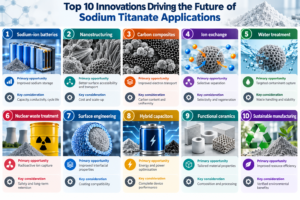
These areas represent a mixture of established material concepts, specialised applications, and ongoing research. The maturity and suitability of each depend on the particular sodium titanate composition and application.
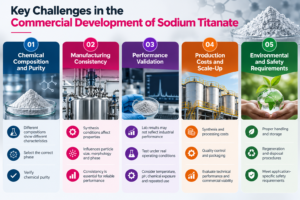
Key Challenges in the Commercial Development of Sodium Titanate
Despite its potential, sodium titanate faces several challenges that influence its wider industrial adoption.
1. Chemical Composition and Purity
Different sodium titanate compositions have different characteristics. Selecting the correct phase and verifying chemical purity are essential for reliable performance.
2. Manufacturing Consistency
Changes in synthesis conditions can affect particle size, morphology, phase composition, and other properties. Consistency is especially important when a material is incorporated into a larger manufacturing process.
3. Performance Validation
Laboratory results may not directly represent industrial performance. Material testing should reflect the actual operating environment, including temperature, pH, chemical exposure, and repeated use where relevant.
4. Production Costs and Scale-Up
The economics of synthesis, processing, quality control, and packaging can affect commercial viability. Manufacturing processes must be evaluated for both technical performance and cost.
5. Environmental and Safety Requirements
Depending on the application, the material and its associated process may require specific handling, storage, regeneration, or disposal procedures.
Addressing these challenges will require collaboration between material scientists, chemical manufacturers, application engineers, and industrial buyers.
How to Choose the Right Sodium Titanate Supplier
Selecting an appropriate supplier is an important step for businesses exploring sodium titanate for research, development, or industrial use.
Consider the following factors before making a purchasing decision.
Chemical composition: Confirm that the material matches the required sodium titanate composition and phase.
Purity and technical specifications: Review the relevant purity, impurity profile, particle size, moisture content, and other application-specific parameters.
Batch consistency: Reliable specifications and consistent material characteristics support repeatable results.
Technical documentation: Request the available technical data sheet, safety data sheet, and analytical documentation.
Application suitability: Confirm that the material is appropriate for the intended process rather than relying on its general chemical classification.
Supply and packaging: Evaluate quantity requirements, packaging, storage conditions, lead times, and ongoing supply needs.
Testing and validation: Where necessary, conduct application-specific trials before introducing the material into full-scale operations.
A specification-led sourcing process can help businesses reduce uncertainty and identify a material that meets their actual technical requirements.
Why Choose Noble Alchem for Industrial Material Enquiries?
For industrial manufacturers and material developers, identifying a suitable chemical material requires more than understanding its general properties. Technical specifications, documentation, application requirements, and supply considerations all play important roles.
Noble Alchem serves the industrial chemicals and materials sector. Businesses exploring sodium titanate can begin by defining their required composition, application, quantity, and performance criteria.
Please confirm the relevant product grade and availability directly with the company before specifying it for a particular application.
Frequently Asked Questions
1. What is sodium titanate used for?
Sodium titanate is a family of inorganic compounds studied and used in selected applications involving electrochemical energy storage, ion exchange, and specialised functional materials. The exact uses depend on its composition, crystal structure, and verified performance.
2. What are the main properties of sodium titanate?
Depending on its composition, sodium titanate may exhibit ion-storage capability, ion-exchange behaviour, and structural characteristics that are useful in advanced-material research. These properties vary between different sodium titanate phases.
3. How is sodium titanate used in sodium-ion batteries?
Certain sodium titanate compositions, including sodium trititanate, are investigated as anode materials. Their structures can accommodate sodium ions during electrochemical cycling. Researchers are working to improve conductivity, ion transport, and cycle stability.
4. Can sodium titanate be used for water treatment?
Selected sodium titanate and related titanate materials are investigated for the removal of particular dissolved ions. Their effectiveness depends on the target contaminant, solution chemistry, material structure, and operating conditions.
5. What is the role of nanotechnology in sodium titanate applications?
Nanotechnology allows researchers to control particle size, morphology, and surface area. These changes may improve ion transport or access to active sites, although manufacturing costs and scale-up remain important considerations.