
Why a Small White Powder Sits Inside So Many Big Machines
Press the brake pedal on a modern car and there is a good chance a few grams of potassium titanate are working for you. This fine, heat-resistant mineral helps brake pads grip evenly, stops plastic parts from warping in a hot engine bay, and keeps industrial coatings from cracking.
Most people outside a materials lab have never heard of it. Yet procurement teams in the automotive, polymer and coatings sectors ask about it every week, usually with the same three questions: how does it actually help, when is it the right choice, and why should they pay for it instead of a cheaper filler?
This guide answers those questions in plain language. We will walk through where the material is used today, what the research says about its performance, how it compares with sodium titanate, and what to check before you place an order.
What Is Potassium Titanate, and Why Do Engineers Trust It?
Potassium titanate is a family of inorganic compounds made by firing titanium dioxide with a potassium salt, usually potassium carbonate. Chemists write it as K₂O·nTiO₂, where n changes the grade. The hexatitanate form (K₂Ti₆O₁₃) is the industrial workhorse because it stays stable at very high temperatures.
What makes it special is shape as much as chemistry. It can be grown as tiny needle-like whiskers, flat platelets, or rounded non-fibrous granules. Each shape behaves differently once it is mixed into a resin, rubber or paint.
CAS number: 12030-97-6. Typical whisker grades measure well under 5 µm across and roughly 3–30 µm long; ask your supplier for the exact particle data of the grade you buy.
Industrial Applications of Potassium Titanate in Modern Manufacturing
The material earns its place in six main areas. In each one, it solves a specific problem that cheaper fillers struggle with.
1. Brake pads and clutch facings
This is the biggest use by far. When asbestos was phased out of brakes, formulators needed a replacement that could take repeated heat without crumbling. Potassium titanate stepped in.
Inside a pad, it helps hold the friction level steady as the pad heats up, so the brake feels the same on the first stop and the fiftieth. It also reduces pad wear and helps control noise. A 2017 study in Materials Reports found that raising the titanate content increased the pad’s porosity and hardness while lowering its density, which shows how carefully the dose has to be tuned. Japan’s Kubota has supplied the material to brake makers for years and expanded production specifically for automotive pads.
2. Engineering plastics and PTFE seals
Whiskers act like microscopic reinforcing bars inside a polymer. In PTFE, the slippery plastic used for seals and bearings, a small dose makes parts stronger and far more wear-resistant
More is not always better. Research on high-performance PPESK resin showed strength improving up to about 10–20 parts per hundred, then falling as loading reached 40. And not every plastic is a good match: one study found the whiskers actually degraded polycarbonate during compounding. Always trial the grade in your own resin first.
3. Paints and industrial coatings
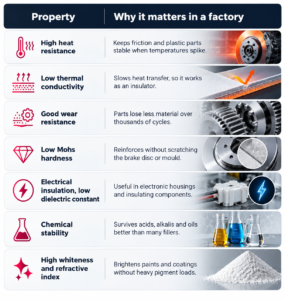
High whiteness and a high refractive index let potassium titanate brighten a coating while adding toughness. Its strong infrared reflectance also makes it useful in heat-reflective coatings for roofs, tanks and machinery housings.
4. Thermal insulation and building materials
Low thermal conductivity means it slows heat flow. That is why it appears in heat-retention panels, high-temperature insulation and some specialist building boards.
5. Electronics and technical ceramics
It insulates electrically and has a low dielectric constant. Manufacturers use it in insulating parts and ceramic bodies where they need stability at heat without electrical leakage.
6. Lubricants, greases and specialty paper
In smaller volumes, it is added to lubricants and heat-resistant paper products, where its stability and fine particle shape help the product hold up under friction and heat.
Where Potassium Titanate Demand Comes From
Brakes and clutches alone take more than half of global supply, which is why the automotive cycle drives prices and lead times. The remaining share is spread across plastics, coatings, insulation and ceramics, and it is growing as more industries look for heat-stable reinforcement.
What a Small Dose Does: Potassium Titanate Whiskers in PTFE
The striking number is wear: in the same study, wear resistance improved roughly tenfold. The researchers found the best all-round balance at 5–10 wt%, and noted that whisker-filled PTFE had a denser, more uniform structure than glass-fibre-filled PTFE. For a seal or bearing maker, that means longer service life from a very small addition.
Potassium Titanate vs Sodium Titanate: Which One Does Your Process Need?
The two names sound almost identical, but buyers use them for very different jobs. Potassium titanate is mainly a structural additive. Sodium titanate is mainly a chemical workhorse that swaps ions.
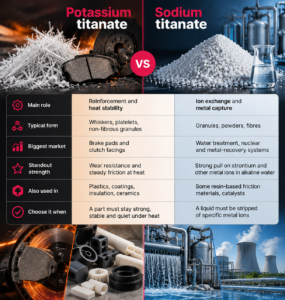
A real-world example shows the difference. Granular sodium titanate has been used to clean radioactive strontium out of the water at Fukushima, a job potassium titanate is not designed for. Sodium titanate does turn up in some resin-based friction blends, but when long pad life at high heat is the priority, formulators usually reach for potassium titanate.
So the question is not which one is better. It is which problem you are solving.
How to Choose Potassium Titanate Manufacturers You Can Rely On
Two lots of the same chemical can perform very differently. Particle shape, purity and moisture all change how the powder mixes and how the finished part behaves. Here is what experienced buyers check.
How to evaluate a supplier
- Grade and shape. Ask whether the product is whisker, platelet or non-fibrous granular, and which titanate phase it is (hexatitanate, octatitanate and so on). Match it to your application, not to the lowest price.
- Particle data on paper. A serious supplier shares average diameter, length or aspect ratio, specific surface area and phase purity for every batch.
- Batch consistency. Request certificates of analysis from three or more past lots. Small swings in particle size can shift the friction level of a brake pad.
- Surface treatment options. Coupling-agent treated grades disperse better in polymers. Ask if they are available.
- Safety documentation. Look for an up-to-date SDS and clear data on fibre content (more on this below).
- Samples and technical support. Good potassium titanate manufacturers will send trial quantities and help you adjust loading levels.
When it makes sense to switch to potassium titanate
- Your brake or clutch formulation shows fade, uneven wear or noise at high temperature.
- A plastic part warps or wears too fast in a hot, moving assembly.
- A coating needs better heat reflection or crack resistance without a heavy pigment load.
- You are reformulating to meet tighter safety rules and need a fibre that is easier to manage than older materials.
Why the right supplier saves money later
The additive is a small share of a brake pad’s weight, but it has a large effect on how the pad performs. A cheaper lot that causes one failed batch, a customer complaint or a re-test quickly costs more than the saving. Consistency is the real value you are paying for.
Safe Handling and the Shift to Non-Fibrous Grades
Any very fine fibre deserves respect on the shop floor. Classic needle-shaped whiskers are bulky, flow poorly and can raise dust during mixing. Because very thin, long fibres are a known workplace health concern, the industry has spent years developing safer forms.
Today you can buy granular, platelet and columnar grades that keep most of the heat and wear benefits while containing very little fibrous material. Several published production methods aim for a fibrous content below 1% by mass. These grades also pour and disperse more easily, which makes mixing faster and cleaner.
Practical tips for your plant:
- Ask the supplier for the fibrous content of the exact grade, not a general brochure figure.
- Use closed transfer or local exhaust ventilation at the mixing station.
- Give operators suitable dust masks and keep housekeeping tight.
- Follow the SDS and your local occupational exposure rules.
Why Buyers Work With Noble Alchem
At Aunkar Vastu, we believe a supplier should make your formulation work easier, not add another variable to it. That is why we approach every enquiry the same way: first understand the part you are making, then recommend the grade.
- Application-first advice. Tell us whether you are making brake pads, PTFE seals, coatings or insulation, and we will point you to the shape and phase that suit it.
- Documentation you can file. Certificates of analysis, SDS and particle data come with your order, so your QA team is not left chasing paperwork.
- Both titanates under one roof. If your plant needs potassium titanate for reinforcement and sodium titanate for an ion-exchange line, you can source both from one partner.
- Trial-friendly ordering. Start with sample quantities, test in your own process, then scale up with confidence.
If you are comparing potassium titanate manufacturers for your next project, send us your application and target specifications. Our team will come back with a grade recommendation and a quote.

Frequently Asked Questions
1. What is potassium titanate mainly used for?
Its largest use is in automotive brake pads and clutch facings, which account for roughly half of global demand. There it keeps the friction level steady as the brake heats up, reduces wear and helps control noise. Beyond friction materials, it reinforces engineering plastics such as PTFE, improves heat reflection and toughness in paints and coatings, and works as an insulating additive in thermal panels, ceramics and electronic parts. In short, it is chosen wherever a material must stay strong and stable under heat and repeated stress.
2. How does potassium titanate improve brake pad performance?
It works in three ways. First, it is heat-resistant, so it does not break down when the pad reaches high temperatures during hard stops. Second, its fine, hard-wearing particles spread friction evenly across the pad face, which keeps braking feel consistent and reduces fade. Third, it has a relatively low hardness, so it reinforces the pad without scoring the brake disc. Formulators usually blend it with resins, fibres and other fillers, and the dose has to be tuned: research shows that changing the titanate content shifts the pad’s porosity, hardness and density.
3. When should a manufacturer use sodium titanate instead of potassium titanate?
Choose sodium titanate when your goal is chemical rather than mechanical. Its structure lets it swap its sodium ions for other metal ions, which makes it excellent at pulling strontium, silver, nickel, cobalt and similar metals out of alkaline water. That is why it is used in nuclear waste treatment and metal-recovery systems. If you need a stronger, more heat-stable or longer-wearing part, potassium titanate is usually the better fit. Many plants use both, each for its own job.
4. Is potassium titanate safe to handle in a factory?
It is a chemically stable, non-reactive material, but like any very fine powder it must be handled with care. The main concern is dust from long, thin fibres, which is why many modern grades are produced in non-fibrous granular or platelet form with very low fibre content. Use local exhaust ventilation at mixing points, give operators suitable respiratory protection, keep work areas clean, and follow the supplier’s SDS. Always ask for the fibre content of the specific grade you are buying.
5. Why choose Aunkar Vastu over other potassium titanate manufacturers?
Because the right grade matters more than the cheapest price. At Aunkar Vastu, we start with your application, recommend the shape and phase that suit it, and back every order with certificates of analysis, SDS and particle data. You can begin with trial quantities, validate the material in your own process, and then scale up. We also supply sodium titanate, so plants that need both materials can simplify their sourcing with a single partner.