
Choosing the right titanate material requires more than comparing chemical names. Sodium titanate and lithium titanate both contain titanium and oxygen, but their compositions, crystal structures, and potential applications can differ significantly. These differences matter when selecting materials for industrial processes, advanced ceramics, or energy-storage research.
Sodium titanate is a family of inorganic compounds investigated for applications such as sodium-ion batteries and specialised ion-exchange processes. Lithium titanate, particularly lithium titanium oxide (Li₄Ti₅O₁₂), is widely studied as an anode material for lithium-ion batteries because of its structural stability during repeated charge and discharge cycles.
Although both materials belong to the titanate family, they are not direct substitutes for one another. Their suitability depends on the intended application, material grade, processing requirements, and verified performance.
In this guide, we explain 10 important differences between sodium titanate and lithium titanate, including their chemical composition, structure, ion-storage behaviour, industrial uses, and material-selection considerations.
What Are Sodium Titanate and Lithium Titanate?
Before comparing their differences, it helps to understand what each material is and why its chemical structure matters.
What is sodium titanate?
Sodium titanate refers to a group of inorganic compounds containing sodium, titanium, and oxygen. One extensively studied composition is sodium trititanate, Na₂Ti₃O₇, which has a layered structure that makes it interesting for sodium-ion storage research.
Depending on its composition and physical form, sodium titanate may also be investigated for ion exchange, specialised separation processes, and functional-material applications. Its properties are not identical across every composition or commercial grade.
Noble Alchem lists sodium titanate powder among its titanate offerings and describes its wider titanate range as serving different applications according to physical and chemical properties.
Noble Alchem
What is lithium titanate?
Lithium titanate is another group of titanium-containing inorganic materials. In battery research, the term commonly refers to lithium titanium oxide, Li₄Ti₅O₁₂, often abbreviated as LTO.
This material has a spinel crystal structure and is valued for its small structural changes during lithium insertion and extraction. These characteristics make it attractive for battery designs where cycle life and operational stability are important.
Lithium titanate is particularly associated with lithium-ion battery anodes, although its practical performance depends on electrode formulation, cell design, and operating conditions.
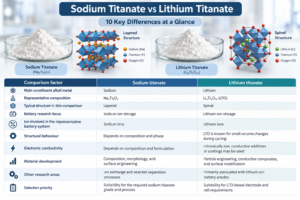
Sodium Titanate vs Lithium Titanate
The following table compares representative forms of the two materials. The sodium titanate column refers primarily to sodium trititanate where a specific composition is necessary; commercial sodium titanate grades may differ.Scientific note: This table compares representative materials, not every compound in either titanate family. Applications and performance cannot be generalised to all compositions.
10 Key Differences Between Sodium Titanate and Lithium Titanate
1. Chemical Composition
The first difference is the alkali metal present in each material.
Sodium titanate contains sodium, while lithium titanate contains lithium. Both include titanium and oxygen, but their chemical formulas depend on the particular compound.
For example, Na₂Ti₃O₇ is a representative sodium trititanate composition, whereas Li₄Ti₅O₁₂ is the commonly studied lithium titanate used in battery anodes.
These formulas are not interchangeable. Differences in elemental ratios affect the resulting crystal structure, electrochemical behaviour, and suitability for a particular application.
Why it matters: When sourcing sodium titanate powder or lithium titanate, buyers should confirm the exact chemical composition and grade rather than relying on the generic term “titanate.”
2. Crystal Structure
Crystal structure describes how atoms are arranged within a solid material. This arrangement can influence ion movement, stability, and interactions with other substances.
Sodium trititanate, Na₂Ti₃O₇, has a layered structure that can accommodate sodium ions during electrochemical cycling. Lithium titanate, Li₄Ti₅O₁₂, has a spinel structure associated with its lithium-storage behaviour.
The two structures create different environments for ion insertion and extraction. Consequently, performance observed in one material cannot automatically be assumed for the other.
Why it matters: Material structure is a key consideration when evaluating battery electrodes, functional inorganic materials, and specialised chemical applications. Composition and crystal phase should be verified using appropriate analytical methods.
3. Primary Battery Applications
Sodium titanate and lithium titanate are associated with different battery chemistries.
Sodium titanate, particularly layered sodium trititanate, is investigated as an anode material for sodium-ion batteries. Sodium-ion technology is being explored for energy-storage applications where sodium-based chemistry may offer advantages in raw-material availability and system-level cost.
Lithium titanate is used as an anode material in lithium-ion battery research and applications. Its structural stability during cycling makes it relevant to systems that prioritise durability and repeated operation.
Why it matters: The choice depends on the battery chemistry and the complete system design. Neither material can be declared universally superior without considering the cathode, electrolyte, operating conditions, and required performance.
4. Ion Storage and Transport
Both materials are relevant to electrochemical research, but they interact with different ions in their representative battery systems.
Sodium titanate structures such as Na₂Ti₃O₇ can accommodate sodium ions. Researchers study their structures and particle morphology to improve ion transport and electrochemical performance.
Lithium titanate accommodates lithium ions in its battery-storage process. Its performance is influenced by its crystal structure, particle size, electrode formulation, and transport properties.
Both materials may face limitations related to electronic conductivity or ion movement. These limitations are addressed through material engineering rather than by assuming that the chemical name alone predicts performance.
Why it matters: Ion-storage capacity, charge rate, and cycle stability must be evaluated using comparable test conditions and complete electrode data.
5. Structural Stability During Battery Cycling
Battery materials repeatedly undergo electrochemical changes during charging and discharging. How well they tolerate those changes can affect service life.
Lithium titanate, particularly Li₄Ti₅O₁₂, is known for its very small volume changes during lithium insertion and extraction. This characteristic contributes to its reputation for good cycling stability.
Sodium titanate behaviour depends on its specific composition and structure. Researchers investigate layered structures, modifications, and electrode designs to improve their stability during repeated sodium-ion cycling.
Why it matters: A material’s structural behaviour can influence electrode durability, but the life of a complete battery also depends on the other cell components and operating conditions.
6. Electronic Conductivity
Electronic conductivity describes how readily electrons move through a material. It is important because battery electrodes need effective pathways for electron transport as well as ion movement.
Selected sodium titanate and lithium titanate materials have relatively low intrinsic electronic conductivity. This can limit their performance when used without appropriate electrode engineering.
Researchers may investigate conductive carbon, particle-size optimisation, surface coatings, or composite formulations to address these challenges. The effectiveness of each approach depends on the material and electrode design.
Why it matters: Buyers and researchers should evaluate the performance of the formulated electrode, not just the base powder. Conductivity figures should be compared only when measurement methods and conditions are consistent.
7. Other Industrial and Research Applications
Battery research is an important area, but it is not the only reason titanate materials attract scientific interest.
Certain sodium titanate-based materials are investigated for ion exchange and specialised separation processes. Depending on composition, related titanate materials may interact with selected dissolved ions in aqueous solutions.
Lithium titanate is most strongly associated with lithium-ion battery anodes, although the broader lithium titanate material family may have other specialised research uses.
Industrial applications must be confirmed for the specific material grade. A result demonstrated for one composition does not prove that another composition will behave identically.
Why it matters: Industrial users should begin with the chemical and process requirements of their application before deciding which titanate is suitable.
8. Raw-Material and Cost Considerations
Sodium and lithium differ in their availability, supply chains, and market economics. These differences can influence the broader cost considerations of sodium-ion and lithium-ion battery technologies.
However, the cost of a titanate material is not determined by the alkali metal alone. Purity, production method, particle characteristics, quality control, packaging, transportation, and required specifications all affect procurement costs.
It would therefore be misleading to claim that sodium titanate powder is always cheaper than lithium titanate or that either material automatically produces a less expensive battery.
Why it matters: Industrial buyers should compare current quotations for equivalent specifications and evaluate total application cost rather than raw-material price alone.
9. Manufacturing and Material Engineering
The manufacturing process influences the chemical phase, particle size, morphology, purity, and consistency of titanate materials.
For sodium titanate, research may focus on controlling layered structures, improving particle morphology, and developing suitable electrode formulations or ion-exchange materials.
For lithium titanate, material engineering commonly focuses on particle-size control, conductive composites, surface modification, and processing methods that support electrode performance.
In either case, the synthesis route must be appropriate for the desired application. Laboratory performance does not automatically translate into consistent results at industrial scale.
Why it matters: Technical documentation, batch consistency, analytical testing, and application-specific validation are essential when choosing a material supplier.
10. Choosing the Right Material for Your Application
The final decision should be based on the job the material needs to perform.
Sodium titanate may be appropriate when a process specifically requires a suitable sodium titanate composition, such as for research into sodium-ion storage or selected ion-exchange applications.
Lithium titanate may be the better fit when designing an LTO-based lithium-ion battery electrode and its associated cell system.
For industrial applications outside battery technology, the choice requires a more specific evaluation of chemical compatibility, operating conditions, and verified performance.
Before purchasing, confirm:
- Exact chemical composition and crystal phase.
- Purity and impurity limits.
- Particle size, morphology, and moisture specifications.
- Relevant technical and safety documentation.
- Compatibility with the intended process.
- Batch consistency, packaging, and supply requirements.
- Results from application-specific testing.
Why it matters: Selecting a material by its name alone can lead to unsuitable specifications, unexpected processing issues, or disappointing performance.
Which Is Better: Sodium Titanate or Lithium Titanate?
Neither material is universally better. Each has different chemical characteristics and potential uses.
Choose sodium titanate when the required application calls for a specific sodium-based titanate composition and its properties have been validated for that process. For sodium-ion battery research, the layered structure of selected sodium titanates is particularly relevant.
Consider lithium titanate when evaluating Li₄Ti₅O₁₂ for lithium-ion battery anodes, especially when small structural changes during cycling are an important design consideration.
For industrial procurement, the most reliable approach is to define the application first, establish measurable material requirements, and compare suppliers against those requirements. The best material is the one that meets the technical specification and performs consistently under actual operating conditions.
How Noble Alchem Supports Industrial Titanate Requirements
For industrial buyers, selecting a titanate involves more than identifying the correct chemical family. The material must also meet the required specifications, quality expectations, and supply needs.
Noble Alchem manufactures and supplies a range of titanate materials, including sodium titanate powder. The company describes its approach as application-focused, with different titanate products selected according to their physical and chemical properties.
Conclusion
Sodium titanate and lithium titanate share titanium and oxygen as important constituents, but their different compositions and structures give them distinct characteristics. Sodium trititanate is investigated for sodium-ion storage and selected ion-exchange applications, while lithium titanium oxide (Li₄Ti₅O₁₂) is an established material of interest for lithium-ion battery anodes.
The right choice depends on the application, chemical composition, structural properties, performance requirements, and overall economics. Comparing verified technical specifications is more reliable than assuming one material is better in every situation.
For businesses sourcing sodium titanate powder, Noble Alchem provides a starting point for discussing industrial titanate requirements. Contact the company to confirm the appropriate grade, specifications, and availability for your application.
Frequently Asked Questions
1. What is the main difference between sodium titanate and lithium titanate?
The primary difference is their chemical composition: sodium titanate contains sodium, while lithium titanate contains lithium. Representative examples are Na₂Ti₃O₇ and Li₄Ti₅O₁₂, respectively. Their structures and electrochemical behaviours differ, which influences their potential applications. Sodium trititanate is investigated for sodium-ion batteries, while lithium titanate is widely studied for lithium-ion battery anodes.
2. Is sodium titanate used in batteries?
Yes. Certain sodium titanate compositions, including sodium trititanate, are investigated as anode materials for sodium-ion batteries. Their layered structures can accommodate sodium ions during electrochemical cycling. Researchers are exploring ways to improve conductivity, ion transport, and cycling stability. Actual performance depends on the material composition, electrode formulation, electrolyte, and battery design.
3. Why is lithium titanate used in lithium-ion batteries?
Lithium titanium oxide (Li₄Ti₅O₁₂) is valued for its structural stability during repeated lithium insertion and extraction. It undergoes very small volume changes during cycling, making it attractive for battery designs that prioritise durability. However, its energy-storage performance, charging behaviour, and overall suitability depend on the electrode formulation and complete battery system.
4. Is sodium titanate cheaper than lithium titanate?
Not necessarily. The purchase price depends on the specific composition, purity, manufacturing process, particle characteristics, quantity, and supplier. Although sodium and lithium have different raw-material supply chains, these differences alone do not establish which titanate is cheaper. Buyers should request quotations for materials with comparable technical specifications and evaluate the total cost of using them in their intended process.
5. How can I choose a reliable sodium titanate supplier?
Start by confirming the required chemical composition, purity, crystal phase, particle size, and intended application. Request the available technical data sheet, safety data sheet, and relevant analytical documentation. Also assess batch consistency, packaging, delivery requirements, and the supplier’s ability to meet your specifications. For industrial use, application-specific testing is advisable before full-scale adoption. Noble Alchem lists sodium titanate among its titanate products; confirm the required grade and availability directly with the company.