The demand for reliable, efficient and cost-effective energy storage is growing rapidly. From renewable energy systems and electric mobility to large-scale grid storage, industries are looking for battery technologies that can support a more sustainable energy future.
Lithium-ion batteries have dominated the rechargeable battery market for years. However, increasing demand for lithium, concerns about supply-chain concentration and the need for alternative energy storage solutions have encouraged researchers to explore other battery chemistries.
One promising alternative is sodium-ion battery technology.
Among the materials being investigated for this technology, sodium titanate has attracted research interest because of its distinctive crystal structures, sodium-ion storage characteristics and potential applications as an electrode material.
But what makes this material interesting? How does it interact with sodium ions? And why could it become relevant to the next generation of energy storage systems?
In this article, we explore its chemistry, potential benefits, battery applications, research challenges and future possibilities.
1. Understanding Sodium Titanate: What Makes This Material Important?
Sodium titanate refers to a family of inorganic compounds containing sodium, titanium and oxygen. These materials can exist in different chemical compositions and crystal structures depending on their synthesis conditions.
One commonly studied composition is sodium dititanate, Na₂Ti₃O₇. Other sodium titanate phases have also been investigated for their functional and electrochemical properties.
Their structures are particularly interesting because certain arrangements can provide pathways for sodium-ion movement.
This characteristic makes selected sodium titanate materials relevant to battery research.
Key material characteristics
- Structural versatility: Different crystal phases can provide different electrochemical properties.
- Sodium-ion interaction: Certain structures can accommodate sodium ions during electrochemical processes.
- Titanium-based chemistry: Titanium-containing frameworks are being explored for stable electrode materials.
- Research flexibility: Composition, morphology and synthesis conditions can be modified to investigate performance.
- Industrial relevance: Beyond batteries, sodium titanates are studied for ion exchange, ceramics and environmental applications.
An important distinction is that not every sodium titanate composition behaves identically. Its suitability depends on the specific crystal structure, particle size, preparation method and intended application.
2. Sodium Titanate in Next-Generation Sodium-Ion Batteries: How Does It Work?
A sodium-ion battery works on a principle similar to a lithium-ion battery. Instead of lithium ions, it uses sodium ions to transfer charge between two electrodes during charging and discharging.
In certain sodium titanate materials, the crystal structure can provide sites where sodium ions may be inserted and extracted.
This process is known as intercalation.
How the battery process works
1: Charging begins
An external electrical source drives sodium-ion movement through the electrolyte towards the negative electrode.
2: Sodium-ion insertion
Sodium ions enter suitable storage sites within the electrode material. In selected titanate structures, this involves changes in sodium occupancy and the oxidation state of titanium.
3: Energy is stored
The electrochemical system maintains a difference in chemical potential between its electrodes, allowing energy to be stored.
4: Discharging releases energy
When the battery powers an external device, sodium ions move back towards the positive electrode, while electrons flow through the external circuit.
5: The cycle repeats
The battery can repeat this process through multiple charge and discharge cycles, depending on the stability of its electrode materials and overall cell design.
Why is the crystal structure important?
The arrangement of atoms inside an electrode material affects how easily sodium ions can move.
A suitable structure may help improve:
- Sodium-ion diffusion.
- Electrochemical reaction kinetics.
- Structural stability during cycling.
- Reversible sodium storage.
- Overall electrode performance.
This is why material engineering is an important part of developing better sodium-ion batteries.
3. Why Are Researchers Exploring This Material for Battery Development?
The growing interest in alternative battery chemistries is driven by the need for more flexible and resilient energy storage supply chains.
Sodium is relatively abundant and widely distributed compared with lithium. This makes sodium-based battery systems attractive for applications where material availability and cost are important considerations.
Here are some reasons researchers are investigating this material.
-
Potential for Low-Voltage Sodium Storage
One of the most interesting characteristics of Na₂Ti₃O₇ is its low average operating potential, approximately 0.3 V versus Na⁺/Na in reported studies.
A low-potential anode can contribute to higher full-cell voltage when paired with a suitable cathode.
However, low operating voltage alone does not guarantee better battery performance. Electrode stability, electrolyte compatibility and full-cell design are equally important.
-
Sodium Availability and Material Diversification
Lithium supply chains face growing demand from electric vehicles, portable electronics and energy storage installations.
Sodium offers an opportunity to diversify the raw-material base for rechargeable batteries.
Titanium-based electrode materials are also being explored as alternatives to conventional carbon-based anodes.
-
Potential Structural Stability
Certain sodium titanate structures can accommodate sodium ions through reversible electrochemical reactions.
Maintaining structural integrity during repeated insertion and extraction is important because excessive structural changes can reduce battery capacity over time.
Researchers are investigating different synthesis and surface-modification techniques to improve this characteristic.
-
Opportunities for Material Engineering
The performance of an electrode is not determined by chemical composition alone.
Particle morphology, crystallinity, surface chemistry and electrical conductivity all influence electrochemical behaviour.
This creates opportunities for developing modified sodium titanate materials suited to specific battery requirements.
4. Key Benefits and Technical Advantages
The potential advantages of this material can be understood by examining its chemical and electrochemical characteristic
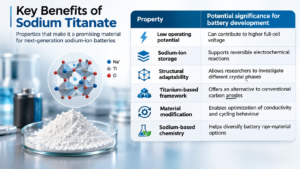
Can sodium titanate improve battery safety?
Safety is one of the major considerations in rechargeable battery development.
The relatively low sodium-storage potential of Na₂Ti₃O₇ has been considered advantageous because it may reduce the likelihood of sodium metal deposition under appropriate operating conditions.
Nevertheless, battery safety depends on the complete cell, including the electrolyte, separator, electrodes, operating temperature and battery management system.
It would therefore be inaccurate to describe any single electrode material as making a battery completely safe.
5. What Does Scientific Research Say About Its Battery Performance?
Recent research has focused on improving the electrochemical performance of sodium titanate through structural modification, surface engineering, conductive coatings and electrolyte optimization.
A 2024 review published in the Chinese Journal of Chemical Engineering examined its synthesis methods, sodium-storage mechanism and practical challenges.
A 2026 review in Energy Advances further discussed modification strategies for improving its performance as a sodium-ion battery anode.
ScienceDirect+1
A practical example from published research
A study published in Energy & Fuels in 2024 investigated an electrolyte-additive approach to stabilize the interface of Na₂Ti₃O₇ anodes.
The researchers reported improvements in specific capacity and capacity retention after introducing tetraethyl orthosilicate (TEOS) into the electrolyte system.
REPORTED EXPERIMENTAL RESULTS — NOT COMMERCIAL PRODUCT SPECIFICATIONS
Effect of electrolyte modification on reported anode performance
Experimental results for Na₂Ti₃O₇ anodes, comparing the baseline and TEOS-modified electrolyte conditions. Values are from one published study.
Baseline
TEOS modified
04590135180Specific capacity (mAh/g)Capacity retention (%)
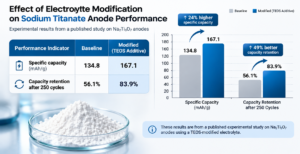
Source: ACS, Building a Stable Plateau-Type Na₂Ti₃O₇ Anode Interface toward Advanced Sodium-Ion Batteries (2024).
ACS Publications
These findings illustrate how electrode-interface engineering can influence performance. They should not be interpreted as guaranteed results for every sodium titanate formulation or commercial battery.
What are the major challenges?
Despite encouraging findings, several issues require further investigation:
- Limited electrical conductivity: Certain sodium titanate structures have relatively low intrinsic conductivity.
- Slow ion diffusion: Sodium ions are larger than lithium ions, which can affect transport kinetics.
- Initial capacity loss: Irreversible reactions can consume sodium during the first cycle.
- Electrode interface instability: Unwanted surface reactions can affect long-term cycling.
- Manufacturing consistency: Particle size, purity and phase composition must be controlled.
- Commercial scalability: Laboratory performance must be validated in larger cells and practical operating conditions.
6. How Is Sodium Titanate Prepared for Advanced Battery Applications?
The preparation method plays an important role in determining the final properties of the material.
Researchers have explored different synthesis routes to produce sodium titanate with controlled crystal structures, particle sizes and surface characteristics.
Some commonly investigated approaches include:
-
Solid-State Reaction
This method involves mixing suitable sodium-containing and titanium-containing precursors, followed by heat treatment.
The reaction temperature, duration and precursor ratio influence the resulting phase and crystallinity.
Why it matters: Solid-state synthesis offers a relatively straightforward route for preparing crystalline materials, although achieving uniform particle characteristics can be challenging.
-
Hydrothermal Synthesis
Hydrothermal preparation uses a controlled chemical reaction in a sealed vessel at elevated temperature and pressure.
It can help produce different particle morphologies and nanostructured materials.
Why it matters: Particle shape and dimensions can influence the surface area and electrochemical behaviour of the final electrode.
-
Sol-Gel Processing
Sol-gel techniques involve chemical precursor solutions that undergo hydrolysis and condensation before drying and heat treatment.
Why it matters: This approach offers opportunities for better compositional control and uniform mixing at the molecular level.
-
Surface Modification and Carbon Coating
Researchers also investigate carbon coatings, conductive additives and composite structures.
These approaches aim to improve electrical conductivity and electrode stability.
The most appropriate preparation technique depends on the desired chemical phase, performance targets, production scale and cost requirements.
7. Sodium Titanate vs Other Anode Materials: How Do They Compare?
Different anode materials offer different advantages. There is no single material that performs best under every battery design and operating condition.
The following table provides a broad technical comparison.
The comparison highlights an important point: sodium titanate is not intended to replace every existing battery material.
Instead, it represents one of several material platforms researchers are evaluating for specialized sodium-ion battery designs.

8. Where Could Sodium Titanate Find Applications in the Future?
As research progresses, several industries could benefit from improvements in sodium-ion battery technology.
The following are potential application areas rather than confirmed commercial applications of sodium titanate specifically.
-
Renewable Energy Storage
Solar and wind power generation can fluctuate depending on weather and environmental conditions.
Energy storage systems help balance electricity supply and demand.
If sodium titanate-based anodes achieve suitable cost, cycle life and performance, they could become relevant to stationary storage battery development.
-
Electric Mobility
Electric two-wheelers, three-wheelers and selected low-speed vehicles are areas where alternative battery chemistries are being explored.
The suitability of sodium titanate will depend on energy density, charging performance, operating temperature and overall cell economics.
-
Grid-Level Energy Storage
Electricity grids increasingly require storage systems to manage renewable energy integration and peak demand.
Sodium-ion technology is being investigated for stationary storage, where cost and operational reliability can be more important than maximum energy density.
-
Industrial Backup Power
Manufacturing facilities, data centres and commercial infrastructure require reliable backup energy.
Future sodium-ion battery developments may provide additional options for industrial energy storage.
-
Research and Advanced Materials Development
Universities, battery manufacturers and material science laboratories may continue investigating sodium titanate for electrode engineering, composite materials and improved electrochemical performance.

Frequently Asked Questions
1. What is sodium titanate, and why is it used in sodium-ion battery research?
Sodium titanate is a group of inorganic compounds containing sodium, titanium and oxygen. Certain compositions, particularly Na₂Ti₃O₇, have attracted attention as potential anode materials for sodium-ion batteries.
Their crystal structures can accommodate sodium ions during electrochemical charging and discharging. Researchers are studying these materials because of their low operating potential and potential for reversible sodium storage.
2. How does sodium titanate work as an anode material?
Certain sodium titanate structures store sodium ions through an electrochemical insertion and extraction process known as intercalation.
During charging, sodium ions move through the electrolyte and enter suitable sites within the anode structure. During discharging, they move back towards the positive electrode while electrons travel through the external circuit.
The ability to repeat this process depends on the material’s structural stability, conductivity and compatibility with the electrolyte.
3. What are the main advantages of sodium titanate in battery technology?
The major research advantages include:
- Low operating potential in selected compositions.
- Ability to accommodate sodium ions.
- Potential for reversible electrochemical reactions.
- Structural flexibility through material engineering.
- Opportunities for conductivity and surface modifications.
These characteristics make it an interesting candidate for advanced battery research. Its practical performance still requires further optimization.
4. Is sodium titanate commercially used in sodium-ion batteries?
Sodium titanate, particularly Na₂Ti₃O₇, is primarily an active area of research as a sodium-ion battery anode.
Although published studies demonstrate promising electrochemical results, its widespread commercial adoption as a battery electrode has not been established.
Commercial viability will depend on manufacturing costs, energy density, cycle life, conductivity, safety and performance in full battery cells.
5. What factors influence the quality and performance of sodium titanate?
Several factors influence its performance:
- Chemical purity: Impurities can affect electrochemical reactions and material consistency.
- Crystal structure: Different phases exhibit different sodium-storage characteristics.
- Particle size: Particle dimensions can influence ion diffusion and surface reactions.
- Synthesis method: Preparation conditions affect crystallinity and morphology.
- Surface chemistry: Surface modification can improve electrode-electrolyte compatibility.
- Electrical conductivity: Conductive coatings and composites may improve charge transfer.