
Geopolymer technology has become an important area of research for developing alternative binder systems for more sustainable construction. Unlike conventional Portland cement-based systems, geopolymer binders can be produced by activating reactive aluminosilicate materials with alkaline solutions.
But simply combining a precursor material with an activator does not guarantee consistent performance.
The final properties of a geopolymer depend on several interconnected factors, including the type and chemistry of the precursor, alkali activators geopolymer concrete , activator ratio, water content, curing conditions, mixing process, and material compatibility.
This is where understanding an alkaline activator geopolymer system becomes important.
For manufacturers, concrete producers, researchers, and construction-material professionals, controlling these parameters can make the difference between a workable mixture with reliable strength and one that shows inconsistent setting, poor workability, or inadequate mechanical performance.
What Is an Alkaline Activator Geopolymer?
A geopolymer is generally produced when a reactive aluminosilicate source interacts with an alkaline activating solution.
Common precursor materials include:
- Fly ash
- Ground granulated blast-furnace slag (GGBS)
- Metakaolin
- Other reactive aluminosilicate-rich industrial or mineral materials
Common alkaline activators include sodium hydroxide, potassium hydroxide, sodium silicate, and potassium silicate. Sodium hydroxide and sodium silicate combinations are particularly common in geopolymer concrete research.
The alkaline environment helps dissolve reactive silicon and aluminium species from the precursor. These dissolved species then participate in subsequent reactions and form a hardened aluminosilicate network.
In simple terms:
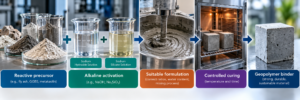
However, each part of this process needs to be controlled.
Key Factors That Affect Geopolymer Performance
The performance of a geopolymer cannot usually be attributed to one ingredient alone. Several variables work together.
The major factors include:
- Precursor material characteristics
- Activator type
- Activator concentration or molarity
- Sodium silicate-to-sodium hydroxide ratio
- Activator-to-binder ratio
- Water content
- Curing temperature
- Curing duration
- Mixing and workability
- Aggregate characteristics
- Material consistency and quality control
Research reviews consistently identify activator concentration, activator ratios, curing conditions, water content, and precursor characteristics as important parameters controlling geopolymer properties.
1. Precursor Material and Its Chemical Composition
Before selecting an activating system, it is important to understand the material being activated.
Fly ash, GGBS, metakaolin, and other aluminosilicate sources can differ significantly in their:
- Silicon content
- Aluminium content
- Calcium content
- Particle size
- Amorphous phase
- Mineral composition
- Reactivity
These differences influence how readily the material reacts with the alkaline solution.
For example, a precursor containing a high proportion of reactive amorphous phases may respond differently to an activator than a material containing more crystalline or less reactive phases.
This means an activator formulation should not be treated as a universal recipe.
The chemistry of the precursor should be considered before deciding the concentration and ratio of the activating system.
2. Type of Alkaline Activator
The choice of activator directly influences the reaction environment.
Frequently studied activators include:In many geopolymer systems, hydroxide and silicate solutions are combined rather than used independently.
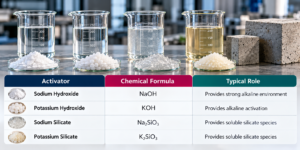
The hydroxide component promotes dissolution of reactive species, while soluble silicate contributes additional silicon and influences the development of the binder structure.
The appropriate combination depends on the precursor, desired workability, curing method, and target performance.
3. Activator Concentration or Molarity
One of the most important variables is the concentration of the hydroxide solution.
Molarity indicates the concentration of the dissolved chemical in the solution. Changing the concentration changes the chemical environment in which geopolymerization takes place.
A higher concentration can improve dissolution of reactive aluminosilicate species up to an appropriate range. However, more concentrated does not automatically mean better performance.
Research has found that increasing alkalinity can improve strength up to a certain point, after which further increases may provide limited benefit or even reduce performance depending on the system.
Therefore, the objective should be optimization rather than simply maximizing concentration.
Why does concentration matter?
Because the activator concentration can influence:
- Dissolution of the precursor
- Reaction rate
- Setting behaviour
- Strength development
- Workability
- Microstructure
The optimum concentration varies according to the precursor and the rest of the mix design.

4. Sodium Silicate-to-Sodium Hydroxide Ratio
The ratio between sodium silicate and sodium hydroxide is another major consideration.
In many geopolymer systems, these two components work together. Changing their proportion can influence:
- Workability
- Reaction kinetics
- Setting
- Strength development
- Final microstructure
Sodium silicate solutions are generally more viscous than sodium hydroxide solutions. Therefore, increasing the silicate proportion can affect the flow and handling characteristics of the fresh mixture.
Published research commonly investigates sodium silicate-to-sodium hydroxide ratios within different ranges, but there is no single ratio that should be considered universally optimal. The appropriate value depends on precursor chemistry and the intended application.
This is an important point for manufacturers: formulation should be performance-driven rather than based on a fixed ratio copied from another mix.
5. Activator-to-Binder Ratio
The amount of activating solution relative to the solid binder also influences geopolymer performance.
Too little activating solution can make the mixture difficult to process and may limit effective reaction.
Too much liquid can increase the liquid content and potentially affect:
- Strength
- Porosity
- Drying behaviour
- Dimensional stability
- Workability
The right balance is therefore essential.
Recent reviews of geopolymer concrete continue to identify activator-to-binder ratio as one of the major parameters affecting both fresh and hardened properties.
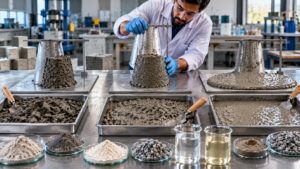
6. Water Content and Workability
Water plays a different role in geopolymer systems than simply acting as a conventional mixing ingredient.
The water-to-binder relationship affects the consistency, flow, reaction environment, and eventual pore structure.
A mix with insufficient liquid may become difficult to mix and compact. Excessive water, on the other hand, can increase porosity after hardening and negatively affect mechanical performance.
Workability is particularly important because alkaline activating solutions can be relatively viscous.
A 2026 systematic review of geopolymer concrete research identified activator molarity, water-to-binder ratio, and sodium silicate-to-sodium hydroxide ratio as important variables governing fresh-state behaviour.
7. Curing Temperature
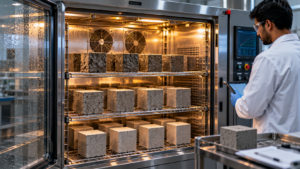
Curing conditions can significantly influence geopolymer development.
For some systems, elevated-temperature curing accelerates the chemical reactions and helps develop early strength.
Research has shown that curing temperature can significantly influence dissolution, reaction kinetics, microstructure, and compressive strength.
However, this does not mean that higher temperatures are always better.
Excessive temperature can cause undesirable effects such as:
- Moisture loss
- Cracking
- Changes in pore structure
- Reduced performance in some formulations
The optimum temperature depends on the precursor, activator chemistry, moisture conditions, and curing duration.
When is heat curing useful?
Heat curing can be particularly useful for certain geopolymer systems where accelerated strength development is required.
However, ambient-cured systems are also being investigated extensively, especially for practical construction applications.
8. Curing Duration
Temperature is only one part of curing.
The duration of curing also affects how the geopolymer structure develops.
A suitable curing period provides sufficient time for the reactions to progress and for the hardened network to develop.
Studies have shown that both curing temperature and duration can influence compressive strength, with the effect depending on activator concentration and precursor composition.
Therefore, curing should be treated as part of the overall formulation, not as an afterthought.
9. Mixing Procedure and Sequence
Even a well-designed formulation can perform poorly if the mixing process is inconsistent.
The sequence and duration of mixing can affect how uniformly the activator interacts with the precursor and other ingredients.
Important considerations include:
- Uniform dispersion
- Mixing duration
- Addition sequence
- Temperature of ingredients
- Activator preparation
- Resting time where applicable
- Consistent batching
For industrial production, process consistency is particularly important.
Two batches with identical nominal formulations can behave differently if their mixing conditions vary significantly.
10. Aggregate Size and Quality
When geopolymer binders are used to produce concrete, aggregate characteristics become another important variable.
Aggregate properties such as:
- Particle size distribution
- Shape
- Surface texture
- Moisture content
- Cleanliness
- Aggregate-to-binder ratio
can affect fresh and hardened properties.
A well-graded aggregate system can contribute to improved packing and reduce unnecessary paste demand.
This is why geopolymer concrete should be evaluated as a complete material system, rather than focusing only on the activator.
11. Temperature and Material Storage
The storage conditions of the activator and precursor materials can also influence consistency.
Changes in:
- Temperature
- Moisture
- Storage duration
- Container condition
- Material contamination
can affect the quality of raw materials.
For commercial production, proper storage and batch testing help maintain predictable results.
This is especially important when producing activator systems at scale, where small variations can become significant across multiple batches.
A Practical Approach to Optimizing Geopolymer Performance
Instead of changing several variables simultaneously, a systematic approach can provide more reliable results.
Step 1: Characterize the precursor
Determine its chemical composition, particle characteristics, and reactivity.
Step 2: Select the activator system
Choose the appropriate hydroxide, silicate, or combination based on the precursor.
Step 3: Establish concentration ranges
Test practical concentration levels rather than assuming the highest concentration will deliver the best result.
Step 4: Optimize the activator ratio
Evaluate different silicate-to-hydroxide proportions.
Step 5: Control liquid content
Adjust water and activating solution to achieve the required balance between workability and strength.
Step 6: Evaluate curing conditions
Compare appropriate curing temperatures and durations for the selected formulation.
Step 7: Test fresh and hardened properties
Evaluate parameters such as:
- Slump/workability
- Setting behaviour
- Compressive strength
- Flexural strength
- Water absorption
- Durability indicators
Step 8: Validate repeatability
A formulation should not only perform well once. It should deliver consistent results across batches.
How Noble Alchem Supports Alkaline Activation Requirements
For companies working with geopolymer and alkali-activated material systems, the quality and consistency of chemical inputs are important parts of formulation development.
Noble Alchem focuses on industrial chemical solutions and supports applications where controlled chemical performance and consistent material quality are important.
For geopolymer-related applications, the selection of an activating system should always consider the precursor chemistry, desired performance, processing conditions, and final application rather than treating the activator as an isolated ingredient.
For technical requirements, formulation guidance, or application-specific chemical requirements, working with a knowledgeable chemical supplier can help manufacturers evaluate the right approach for their process.
Why Choosing the Right Activator Matters
An alkaline activator is not simply a chemical additive added to concrete.
It participates in the chemistry responsible for transforming reactive aluminosilicate materials into a hardened binder.
The right activating system can help achieve the desired balance of:
- Reactivity
- Workability
- Setting
- Strength development
- Durability
- Processing requirements
But the “right” system depends on the entire formulation.
A sodium-based activating system that performs well with one precursor may not deliver identical results with another.
That is why testing, characterization, and formulation control remain essential.
Key Takeaways
The performance of an alkaline-activated geopolymer depends on much more than the choice of one chemical.
The most important factors include:
- Precursor chemistry and reactivity
- Activator type
- Activator concentration
- Sodium silicate-to-sodium hydroxide ratio
- Activator-to-binder ratio
- Water content
- Mixing process
- Curing temperature
- Curing duration
- Aggregate properties
- Raw-material consistency
The best results generally come from optimizing these parameters together, rather than maximizing any single variable.
For manufacturers and researchers, this approach can improve formulation consistency and help develop geopolymer systems suited to specific performance requirements.
Frequently Asked Questions
1. What is an alkaline activator geopolymer?
An alkaline activator geopolymer is a binder system produced by activating reactive aluminosilicate materials with an alkaline solution. Common precursors include fly ash, GGBS and metakaolin, while commonly studied activators include sodium hydroxide, potassium hydroxide, sodium silicate and potassium silicate.
The alkaline environment helps dissolve reactive silicon and aluminium species, which then participate in the formation of the hardened geopolymeric structure.
2. What factors affect geopolymer concrete strength?
Several factors can influence strength, including precursor chemistry, activator concentration, activator-to-binder ratio, sodium silicate-to-sodium hydroxide ratio, water content, curing temperature, curing duration and aggregate characteristics.
There is no universal formulation that produces the same result across every geopolymer system. Research consistently shows that these parameters interact with one another, making formulation-specific testing important.
3. Why are alkali activators important in geopolymer concrete?
Alkali activators create the chemical environment required to activate reactive aluminosilicate materials. Hydroxide-based activators can promote dissolution, while soluble silicates can contribute reactive silica and influence the development of the binder structure.
The combination and concentration of the activators can therefore affect workability, setting, strength and other performance characteristics.
4. Does increasing activator concentration always increase geopolymer strength?
No.
Increasing activator concentration can improve dissolution and strength development within an appropriate range, but excessive concentration does not necessarily continue the same improvement. Depending on the materials and formulation, overly high alkalinity can negatively affect workability or hardened performance.
The optimum concentration should therefore be determined experimentally for the particular precursor and mix design.
5. How does curing temperature affect geopolymer concrete?
Curing temperature can influence the rate of geopolymerization and development of mechanical properties. Elevated-temperature curing can accelerate reaction and early strength development in many systems, but excessively high temperatures may cause moisture loss or other undesirable effects.
The appropriate curing temperature and duration depend on the precursor, activator chemistry and intended application.