
A Complete Guide for Industrial Buyers
When industrial manufacturers evaluate chemical products, quality is never just about meeting a specification sheet. It directly affects operational efficiency, product consistency, production costs, equipment reliability, and customer satisfaction.
Whether it is used in mining, detergents, construction chemicals, foundries, ceramics, paper manufacturing, textile processing, or water treatment, the performance of sodium silicate depends on several critical manufacturing and quality parameters.
Businesses looking for a reliable sodium silicate supplier often compare pricing first. However, experienced procurement professionals understand that selecting the right manufacturing partner involves much more than cost. Consistent quality, controlled production, technical expertise, laboratory testing, and dependable logistics all contribute to long-term business success.
Likewise, companies searching for a dependable sodium silicate manufacturer increasingly focus on suppliers capable of delivering uniform product quality across every shipment. This becomes even more important for export markets where consistent specifications are essential.
Today, a leading sodium silicate manufacturer in India is expected to deliver not only high-quality products but also technical guidance, customized formulations, international packaging standards, and reliable export capabilities for industries across South Africa, the Middle East, Southeast Asia, and Europe.
This guide explains the most important factors that determine sodium silicate quality, how they influence industrial performance, and what buyers should consider before selecting a manufacturing partner.
Why Does Sodium Silicate Quality Matter?
Many industrial buyers assume all sodium silicate products perform similarly because they share the same chemical composition. In reality, even small differences in manufacturing quality can significantly influence production efficiency.
Poor-quality material may result in:
- Inconsistent viscosity
- Reduced bonding performance
- Lower chemical stability
- Higher production waste
- Equipment scaling
- Variable curing performance
- Increased maintenance costs
- Customer complaints
- Lower finished product quality
On the other hand, consistently manufactured sodium silicate provides predictable performance across multiple industrial applications.
Some of the most noticeable benefits include:
| Performance Factor | High-Quality Product | Poor-Quality Product |
| Batch Consistency | Excellent | Variable |
| Process Stability | High | Unpredictable |
| Chemical Purity | High | Moderate |
| Production Efficiency | Better | Lower |
| Equipment Maintenance | Less Frequent | More Frequent |
| Product Shelf Life | Longer | Reduced |
| Customer Satisfaction | Higher | Lower |
For industries operating continuous production lines, consistency often matters more than achieving the lowest purchase price.
Understanding the Sodium Silicate Manufacturing Process
Every stage of production contributes to the final product’s performance.
The manufacturing process typically begins with carefully selected silica sand and soda ash. These raw materials are heated at extremely high temperatures to create molten sodium silicate.
After melting, the material undergoes controlled dissolution, filtration, quality testing, and packaging.
Each stage requires precise control because minor deviations may affect:
- Chemical composition
- Viscosity
- Modulus ratio
- Solubility
- Stability
- Appearance
- Storage performance
Manufacturers that invest in modern process automation are generally able to maintain tighter production tolerances than facilities relying on older equipment.
This consistency becomes especially valuable for export customers who require every shipment to match previously approved specifications.
Raw Material Quality: The Foundation of Product Performance
The quality of sodium silicate begins long before manufacturing starts.
Raw material selection plays one of the most important roles in determining the final product’s performance.
High-Purity Silica Sand
Silica sand forms the backbone of sodium silicate manufacturer .
Higher purity silica contributes to:
- Better transparency
- Improved chemical stability
- Consistent viscosity
- Better industrial performance
- Longer product life
Impurities may introduce unwanted contaminants that affect multiple industrial processes.
Soda Ash Quality
Soda ash influences:
- Reaction efficiency
- Chemical balance
- Production consistency
- Final modulus
- Dissolution characteristics
Maintaining consistent raw material sourcing allows manufacturers to reduce variation between production batches.
Comparison of Raw Material Quality
| Parameter | Premium Grade Raw Materials | Standard Grade Materials |
| Silica Purity | Very High | Moderate |
| Contaminants | Minimal | Higher |
| Production Stability | Excellent | Variable |
| Batch Uniformity | High | Moderate |
| Product Performance | Excellent | Inconsistent |
Importance of Chemical Modulus
One of the most important technical characteristics is the silica-to-sodium oxide ratio, commonly known as the modulus.
The modulus directly influences:
- Solubility
- Alkalinity
- Adhesive strength
- Drying behavior
- Chemical resistance
- Industrial compatibility
Different industries require different modulus values depending on their production process.
| Industry | Preferred Characteristics |
| Detergents | High solubility |
| Construction | Strong bonding |
| Foundry | Reliable binder performance |
| Water Treatment | Stable chemical behavior |
| Ceramics | Controlled drying |
| Paper | Uniform coating properties |
Rather than selecting one universal grade, manufacturers often customize formulations based on specific industrial requirements.
Manufacturing Precision and Process Control
Even when high-quality raw materials are used, production precision ultimately determines product consistency.
Modern facilities monitor:
- Furnace temperature
- Mixing ratios
- Reaction time
- Pressure
- Filtration
- Density
- Viscosity
- Batch traceability
Advanced automation helps maintain consistent quality across every production cycle.
Manufacturers that follow documented quality procedures can identify and correct process variations before products reach customers.
This level of process control is particularly valuable for industries that require long-term supply consistency, including mining, detergent manufacturing, construction chemicals, and water treatment applications.
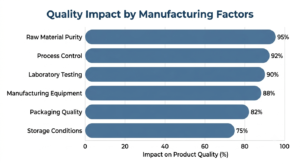
Quality Impact by Manufacturing Factors
FAQ’s
1. What factors affect sodium silicate quality?
Raw material purity, chemical modulus, manufacturing process, laboratory testing, and proper storage all affect sodium silicate quality and performance.
2. Why is chemical modulus important in sodium silicate?
The chemical modulus determines solubility, alkalinity, bonding strength, and suitability for different industrial applications.
3. Which industries use sodium silicate?
Sodium silicate is widely used in detergents, construction, mining, foundries, paper, ceramics, textiles, and water treatment.
4. How do I choose the best sodium silicate manufacturer in India?
Choose a sodium silicate manufacturer in India that offers consistent quality, technical support, modern manufacturing, and reliable global supply.
5. Why should I buy from a trusted sodium silicate supplier?
A reliable sodium silicate supplier ensures consistent product quality, timely delivery, customized grades, and better industrial performance.