Sodium silicate is available in several physical forms, but two of the most commonly discussed are liquid sodium silicate and solid sodium silicate, including powder and glass forms.
Although both are based on soluble sodium silicate chemistry, they are not interchangeable in every manufacturing process. Their physical form affects handling, storage, transportation, processing, dosing, and ultimately how easily they fit into a particular application.
For a purchasing or production team, the question is therefore not simply “Which sodium silicate is better?” A more useful question is:
Which form matches the process, equipment, storage conditions, and performance requirements of the application?
This guide explains the 9 major differences between liquid and solid sodium silicate and provides a practical framework for selecting the appropriate form.
What Is Sodium Silicate?
Sodium silicate is a family of sodium silicate compounds commonly supplied in aqueous liquid solutions or dry solid forms such as powder, flakes, or glass. Depending on grade and composition, its properties can vary significantly.
Commercial sodium silicates are used in applications including detergents, adhesives and binders, welding electrodes, construction materials, drilling fluids, coatings, paper processing, and other industrial processes.
The term “sodium silicate” does not describe one single fixed formulation. Dry sodium silicates can exist in different compositions, while liquid grades vary in concentration, specific gravity, viscosity, and related specifications.
Liquid vs Solid Sodium Silicate at a Glance
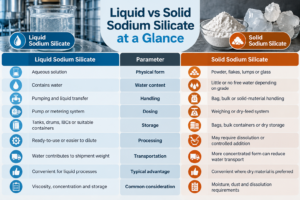
9 Differences Between Liquid and Solid Sodium Silicate
1. Physical Form and Composition
The most obvious difference is the physical state.
Liquid sodium silicate is supplied as an aqueous solution. It can range in concentration and viscosity depending on its grade. For example, commercially supplied liquid grades can differ in Na₂O content, SiO₂ content, specific gravity and viscosity.
Solid sodium silicate can be supplied in forms such as powder, flakes, lumps or glass-like material. PubChem describes sodium silicate in several solid and liquid forms, reflecting the variety of commercial compositions and physical states.
This difference becomes important when designing a production process.
A facility already equipped with liquid dosing pumps may find a liquid grade easier to integrate, while a process designed around dry raw-material handling may favour a powder or solid grade.
2. Water Content
Water is one of the biggest practical differences between the two forms.
Liquid sodium silicate is supplied as a water-based solution. Therefore, a portion of the material being transported and stored is water.
Solid grades contain substantially less free water and can therefore provide a more concentrated form of the material from a logistics and formulation perspective.
This distinction can matter when calculating:
- Raw-material quantities
- Storage requirements
- Shipping weight
- Batch formulation
- Dilution requirements
- Production yield
The actual water content and concentration depend on the specific commercial grade.
Why does water content matter?
Suppose a manufacturing process requires a controlled amount of sodium silicate solids. Using a liquid grade means the process engineer must account for the concentration of the supplied solution.
With a solid grade, the formulation can be based on the dry material and the required amount of water can be introduced separately.
3. Storage Requirements
Storage is another major difference.
Liquid sodium silicate generally requires suitable tanks, drums, IBCs or other compatible containers. Storage conditions need to account for factors such as viscosity, temperature and concentration.
For example, Noble Alchem lists liquid sodium silicate packaging options including 1,000 L IBCs, 200 L plastic drums, flexi tanks and ISO tank containers, depending on the product and requirement.
Solid sodium silicate requires a different storage approach.
Dry products should be protected from moisture and stored according to the manufacturer’s handling recommendations. This is particularly important because sodium silicate solids can be hygroscopic.
Practical difference
Liquid: Think tanks, IBCs, drums and pumps.
Solid: Think bags, dry storage areas, silos or controlled solid-material handling systems.
4. Handling and Dosing
The physical form directly affects how sodium silicate enters a manufacturing process.
Liquid grades can generally be transferred through suitable pumps and pipelines. This can make continuous or controlled liquid dosing relatively straightforward when compatible equipment is available.
Solid sodium silicate, on the other hand, may require:
- Bag handling
- Weighing
- Screw feeding
- Hopper systems
- Controlled dissolution
- Dust-management measures
For automated liquid production systems, a liquid grade may integrate more naturally.
For dry-blending operations, a solid grade may be more practical.
When should you choose based on dosing?
If the production line already uses liquid raw materials and metering pumps, liquid sodium silicate can simplify material handling.
If the process is designed around dry powders, solid sodium silicate may reduce the need for an additional liquid-handling stage.
5. Processing and Dissolution
Another important distinction is what happens before the material enters the final formulation.
Liquid sodium silicate is already present in solution. Depending on the application, it may be used directly or diluted to the required concentration.
Solid sodium silicate may need to be dissolved or incorporated into a formulation before it can perform its intended function.
This does not automatically make one form superior.
Instead, the right choice depends on whether the production process benefits from:
Ready-to-use liquid handling
or
Dry-material storage and controlled dissolution.
For manufacturers developing a new formulation, the dissolution rate, concentration, temperature and mixing requirements should be validated at production scale rather than assumed from laboratory behaviour.
6. Transportation and Logistics
Transportation economics can also differ significantly.
Liquid sodium silicate contains water, so the transported weight includes the water present in the formulation.
Solid sodium silicate provides a more concentrated material format and may be advantageous where dry-material transportation is preferred.
However, transportation decisions are not based on concentration alone.
The buyer should also consider:
- Required quantity
- Distance
- Packaging format
- Loading and unloading equipment
- Frequency of deliveries
- Storage infrastructure
- Local handling capability
For bulk industrial purchasing, the most economical option can depend on the complete supply chain rather than simply the price per kilogram.
A useful purchasing comparison
Instead of comparing only:
Price per kg
compare:
Delivered cost + storage cost + handling cost + processing cost
This provides a more realistic picture of the total cost of using a particular form.
7. Applications Can Differ
Both liquid and solid sodium silicate can serve industrial purposes, but the preferred form often depends on the manufacturing process.
Sodium silicates are used in areas such as detergents, adhesives, paper, welding electrodes, construction, coatings, drilling fluids and other industrial applications.
Noble Alchem, for example, supplies sodium silicate in liquid, powder and glass forms for different industrial requirements.
Examples
Liquid sodium silicate may be considered for:
- Welding electrode binders
- Adhesive systems
- Construction applications
- Floor finishing
- Protective coatings
- Drilling fluids
- Processes requiring liquid dosing
Solid sodium silicate may be considered for:
- Dry formulations
- Detergent manufacturing
- Processes requiring dry raw materials
- Applications where concentrated silicate material is preferred
- Formulations where the manufacturer controls the dissolution step
The exact suitability depends on grade, composition, required modulus, concentration and process conditions.
8. Product Specifications Matter More Than Just “Liquid” or “Solid”
One common purchasing mistake is to compare products only by their physical form.
Two liquid sodium silicates can perform differently.
Two powder grades can also behave differently.
Important specifications may include:
- Na₂O content
- SiO₂ content
- Weight ratio or modulus
- Concentration
- Specific gravity
- Viscosity
- Moisture
- Particle size for powder products
- Purity
- Application-specific requirements
For example, Noble Alchem’s published liquid sodium silicate specifications include different Na₂O and SiO₂ ranges, viscosity, specific gravity and Baumé values for different grades.
This is why industrial buyers should compare technical data sheets, not merely product names.
9. The Right Choice Depends on Your Process
So, which one should an industrial buyer select?
There is no universal answer.
The better option depends on the manufacturing process.
Liquid sodium silicate can make sense when:
- Your process already handles liquid raw materials.
- You need direct pumping or metering.
- Your formulation requires a solution.
- You want to avoid an additional dissolution stage.
- Suitable liquid storage infrastructure is available.
Solid sodium silicate can make sense when:
- Your process is primarily dry.
- You want to control water addition separately.
- Dry-material handling equipment is already available.
- Transportation of concentrated material is beneficial.
- Your formulation requires a powder or glass form.
The final decision should consider the grade, formulation, equipment, storage conditions, logistics and application requirements together.
How to Select the Right Sodium Silicate Grade
Choosing between liquid and solid is only the first step.
Before placing a bulk order, ask your supplier the following questions:
1. What is the required SiO₂/Na₂O ratio?
The ratio can influence how the material behaves in the intended formulation.
2. What concentration is required?
For liquid grades, concentration directly affects formulation calculations, viscosity and handling.
3. Is the process wet or dry?
A wet process may naturally accommodate a liquid grade, while a dry process may favour powder or solid material.
4. What equipment is available?
Check whether your facility has:
- Storage tanks
- Pumps
- Metering systems
- Dry feeders
- Mixing tanks
- Dissolution equipment
5. What packaging works for your plant?
For example, liquid products may be supplied in IBCs or drums, while solid materials can be supplied in suitable dry-material packaging.
6. What does the application require?
A sodium silicate used as a binder may have different requirements from one used in detergents, coatings, drilling fluids or construction.
Sodium Silicate Applications Across Industries
Sodium silicate has a broad industrial role because its chemical and physical properties make it useful as a binder, adhesive, alkaline material, dispersant, sealant or processing component depending on the formulation.
Reported applications include detergents, silica and catalyst production, adhesives and binders, construction materials, drilling fluids, coatings, paper processing and water-treatment-related applications.
Noble Alchem also identifies applications across welding, agriculture, construction, concrete finishing, floor polishing, adhesive manufacturing, coatings and oil-well drilling.
Why Work With an Experienced Sodium Silicate Manufacturer?
For industrial procurement, consistency is often as important as the nominal product specification.
A reliable supplier should be able to provide:
- Consistent batch quality
- Technical specifications
- Appropriate grades
- Application guidance
- Packaging options
- Quality-control information
- Reliable production capacity
- Delivery support
- Technical assistance where required
Noble Alchem states that it has been manufacturing silicates and titanates since 1986 and offers sodium silicate in liquid, powder and glass forms. The company also states that its facilities include production, quality-control and R&D capabilities and that it supplies customers in domestic and international markets.
For buyers evaluating a sodium silicate manufacturer in India, these factors can be useful when comparing potential suppliers.
Frequently Asked Questions
1. What is the difference between liquid and solid sodium silicate?
Liquid sodium silicate is supplied as an aqueous solution, while solid sodium silicate can be supplied as powder, flakes, lumps or glass-like material. The difference affects water content, storage, handling, dosing and processing.
2. Is sodium silicate powder the same as liquid sodium silicate?
They are related forms of sodium silicate, but they are not identical products. Their composition, concentration, moisture content and physical properties can differ. The appropriate form depends on the application and manufacturing process.
3. When should I use liquid sodium silicate?
Liquid sodium silicate can be suitable when a manufacturing process requires a liquid raw material, direct pumping, controlled metering or an aqueous silicate solution. The appropriate grade should be selected according to concentration, modulus, viscosity and application requirements.
4. Why is sodium silicate powder used in industrial applications?
Sodium silicate powder can be useful where a dry raw material is preferred. It can be incorporated into dry formulations or dissolved under controlled conditions depending on the application. The required grade and particle characteristics should be checked before use.
5. How do I choose a sodium silicate manufacturer in India?
Compare manufacturers based on product range, technical specifications, quality consistency, manufacturing capabilities, application expertise, packaging, delivery capability and technical support. A supplier offering multiple forms and grades can also make it easier to match the material to a specific industrial process.