Industrial machinery operates under constant stress, friction, heat, pressure, and abrasion. Over time, this leads to wear and tear, increasing maintenance costs, and reducing equipment life. Manufacturers today are actively searching for advanced materials that improve durability without adding significant weight or cost.
One such high-performance material is potassium titanate.
At Noble Alchem, we work closely with friction material manufacturers, polymer compounders, and industrial component producers who rely on potassium titanate to enhance wear resistance and mechanical strength in demanding environments.
This article explains how potassium titanate improves wear resistance, where it is used, and why industries are increasingly adopting it.
What is Potassium Titanate?
Potassium titanate is an inorganic compound composed of potassium oxide and titanium dioxide. It is available in whisker (fiber) and powder form and is widely used as a reinforcement material.
Its key properties include:
- High hardness
- Excellent thermal stability (stable up to ~1000°C)
- Low thermal conductivity
- Strong chemical resistance
- Good compatibility with polymers and resins
These properties make it ideal for applications where components experience high friction and temperature.
Why Wear Resistance Matters in Industrial Components
Wear resistance directly impacts:
- Equipment lifespan
- Downtime frequency
- Maintenance costs
- Operational efficiency
According to industrial maintenance reports, nearly 23–30% of mechanical failures in manufacturing plants are related to wear and friction damage. In high-friction applications like brake pads, clutch facings, bearings, and polymer gears, selecting the right reinforcement material is critical.
This is where potassium titanate plays a vital role.
How Potassium Titanate Enhances Wear Resistance
1. Reinforcement Through Whisker Structure
Potassium titanate whiskers have a needle-like microstructure. When incorporated into polymers or friction materials:
- They distribute stress evenly
- Reduce micro-cracks
- Improve load-bearing capacity
This reinforcement mechanism significantly improves abrasion resistance.
2. Improved Hardness and Surface Stability
Potassium titanate increases surface hardness in composite materials. Studies show that adding 10–20% potassium titanate fiber in friction materials can:
- Reduce wear rate by up to 30–40%
- Improve compressive strength
- Maintain dimensional stability under heat
This makes it highly suitable for brake pads and industrial clutches.
3. High Thermal Stability in Friction Applications
Industrial components often operate at temperatures exceeding 300°C. Many materials degrade under such heat.
Potassium titanate remains stable at temperatures close to 1000°C, helping:
- Maintain the friction coefficient
- Prevent thermal deformation
- Reduce heat-induced cracking
This is especially important in automotive and heavy machinery applications.
Applications of Potassium Titanate in Wear-Resistant Components
1. Brake Pads and Friction Materials
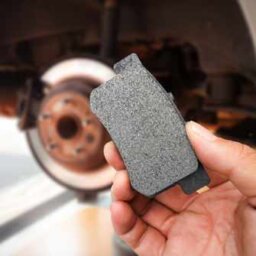
Potassium titanate is widely used as an asbestos-free reinforcement in brake pads. It improves:
- Friction stability
- Wear resistance
- Noise reduction
With global automotive production crossing 90 million vehicles annually, demand for durable and safer friction materials continues to rise.
2. Engineering Plastics and Polymer Composites
Used in:
- Nylon-based gears
- Industrial bushings
- Pump components
It enhances:
- Mechanical strength
- Impact resistance
- Long-term durability
3. Industrial Coatings
Potassium titanate improves scratch resistance and enhances protective coatings for machinery exposed to abrasive environments.
Comparison: Potassium Titanate vs Other Reinforcement Materials
| Property | Potassium Titanate | Glass Fiber | Calcium Carbonate |
| Wear Resistance | High | Moderate | Low |
| Thermal Stability | Up to ~1000°C | ~600°C | Low |
| Density Impact | Low | Moderate | High |
| Chemical Resistance | Excellent | Good | Moderate |
| Friction Stability | Excellent | Moderate | Low |
Conclusion from comparison:
Potassium titanate offers a superior balance between wear resistance and thermal performance compared to commonly used fillers.
Wear Rate Reduction Comparison (Illustrative)
Wear Rate Reduction (%)
Potassium Titanate | ████████████████████ 40%
Glass Fiber | ████████████ 25%
Calcium Carbonate | █████ 10%
This simplified comparison highlights why industries are shifting toward potassium titanate-based reinforcement systems.
Growing Market Demand for Advanced Wear-Resistant Materials
The global friction materials market is projected to grow at over 4–5% CAGR through 2030, driven by:
- Growth in EV manufacturing
- Heavy machinery demand
- Infrastructure development
As industries move away from hazardous materials like asbestos, potassium titanate is emerging as a reliable and compliant alternative.
Why Choose Noble Alchem for Potassium Titanate?
At Noble Alchem, we focus on:
- Consistent particle size distribution
- High-purity material supply
- Reliable bulk availability
- Technical support for formulation development
Our team understands industrial application challenges and works closely with manufacturers to ensure the right grade selection for optimal performance.
Wear resistance is not just about material hardness — it is about maintaining structural integrity under friction, heat, and pressure. Potassium titanate enhances durability by reinforcing composites, improving thermal stability, and reducing abrasion rates.
As industries demand longer-lasting and high-performance components, potassium titanate continues to prove its value as a dependable reinforcement material.
If you are developing advanced friction materials, polymer composites, or industrial components, choosing the right reinforcement can significantly improve product performance and lifecycle.
FAQs
1. What is potassium titanate used for in industrial applications?
Potassium titanate is used in brake pads, friction materials, polymer composites, coatings, and industrial components to improve wear resistance and thermal stability.
2. How does potassium titanate improve wear resistance?
Its whisker-like microstructure reinforces materials, reduces micro-cracks, and enhances hardness, which lowers abrasion rates.
3. Is potassium titanate better than glass fiber for friction materials?
In high-temperature and high-friction environments, potassium titanate often performs better due to its superior thermal stability and friction consistency.
4. Can potassium titanate replace asbestos?
Yes. It is widely used as an asbestos-free reinforcement material in brake pads and industrial friction components.
5. What industries use potassium titanate?
Automotive, heavy machinery, aerospace components, polymer manufacturing, and industrial coatings industries use potassium titanate.
6. Is potassium titanate heat-resistant?
Yes. It remains thermally stable at temperatures approaching 1000°C.
7. How much potassium titanate is typically added to composites?
Typically, 10–20% loading is used depending on the application and required performance characteristics.