
A welding electrode may look simple from the outside, but its coating is the result of a carefully controlled formulation. Mineral powders, alloying materials, arc stabilizers and binding agents all have to work together so that the coating stays intact during manufacturing, storage and welding.
One material that plays an important role in this system is Potassium Silicate Powder.
For welding electrode manufacturers, the material is not simply added to make the coating stick. Its role extends into mixing, paste formation, extrusion, drying and the behaviour of the coating during welding. Potassium-containing silicate systems are also recognized as binder and arc-stabilizing components in electrode coatings.
So, how does it work, when is it added, and why do manufacturers select it for particular electrode formulations?
This guide explains the complete role of potassium silicate in welding electrode manufacturing, from raw-material preparation to the finished rod.
What Makes the Coating of a Welding Electrode So Important?
The metal core is only one part of a coated welding electrode. The outer coating contains a carefully selected mixture of materials that influences how the electrode is manufactured and how it behaves during welding.
Depending on electrode type, the coating may contain materials that perform functions such as:
- Binding the coating ingredients together
- Stabilizing the arc
- Forming and controlling slag
- Providing shielding during welding
- Supporting controlled melting
- Contributing alloying elements
- Helping the coating maintain its physical integrity
The coating therefore needs to satisfy two different requirements.
First, it must be strong enough during manufacturing and handling. Second, it must behave appropriately once exposed to the heat of welding.
This is where an inorganic silicate binder becomes important.
How Is Potassium Silicate Powder Used in Welding Electrode Manufacturing?
During manufacturing, dry flux and mineral ingredients are mixed according to the electrode formulation. A silicate binder is then incorporated into the mixture to create a workable wet mass.
The resulting mixture must have suitable consistency for subsequent forming or extrusion.
Industrial descriptions of electrode production show potassium silicate being added to dry flux mixes before the coating material is formed around the metal core.
The exact formulation, binder concentration and processing conditions vary according to electrode design and manufacturer specifications.
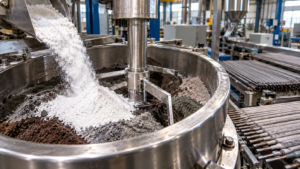
Why Potassium Silicate Works as a Binder
One of the main reasons manufacturers use silicate systems is their ability to hold the coating ingredients together.
The coating contains numerous fine particles. Without an effective binder system, these particles would not form a stable coating around the metal core.
During processing, the binder helps create adhesion between the powdered ingredients and the electrode surface. After drying, the silicate system forms a hardened inorganic structure that helps retain the coating.
Research and industrial references describe sodium and potassium silicates as binding agents that provide coating strength and assist the extrusion process.
This is especially important because the coating has to survive:
- Mixing
- Extrusion
- Drying
- Handling
- Packaging
- Transportation
- Storage
- Electrode loading and use
A coating that is mechanically weak can crack, chip or separate from the core wire before the electrode reaches the welding operation.
How Does It Help During Electrode Extrusion?
Extrusion is a critical manufacturing stage.
The wet coating mixture must have the right consistency to move through the extrusion system and form a reasonably uniform coating around the metal core.
If the mixture is too dry, it may not process properly. If it is too wet or poorly formulated, extrusion behaviour can also become inconsistent.
Silicate binders contribute to the rheological and processing behaviour of the wet mix. Industrial welding references specifically identify silicate binders as materials that aid extrusion.
This means the selection of the binder is connected not only to final electrode performance but also to manufacturing efficiency.
For an electrode manufacturer, consistency from batch to batch is therefore extremely important.
What Happens During Drying and Baking?
After coating, the electrode cannot simply be packaged immediately.
The coated rod must undergo controlled drying and, depending on the electrode type, additional baking or conditioning.
During drying, water is removed from the binder system. Silicate binders can develop a hardened inorganic film as water is lost. This helps transform the wet coating into a more stable solid structure.
The drying stage therefore affects more than moisture content. It also influences the mechanical integrity of the coating.
Manufacturers have to control factors such as:
- Drying temperature
- Drying time
- Moisture content
- Binder characteristics
- Coating thickness
- Electrode formulation
The correct conditions depend on the electrode formulation and production process rather than one universal setting.
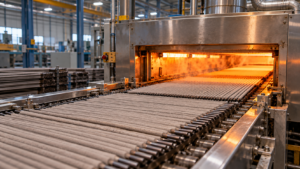
Why Potassium Is Relevant to Arc Stability
The role of the silicate is not necessarily limited to holding the coating together.
Potassium-containing compounds are also associated with arc-stabilizing behaviour in welding electrode systems. UNIDO’s welding-consumables overview notes that potassium is an effective arc stabilizer and that silicate binders can contribute to electrode coating performance.
This is one reason potassium-based silicates have a place in certain electrode formulations.
During welding, the coating is exposed to extremely high temperatures. Its constituents interact with the arc and molten weld pool, and the formulation has to be designed around the desired electrode characteristics.
The binder therefore needs to be considered as part of the overall chemistry rather than as an isolated adhesive.
When Is Potassium Silicate Added During Production?
In a typical electrode production process, the dry coating ingredients are first prepared and mixed.
The silicate binder is then incorporated to convert the dry formulation into a plastic, workable mass suitable for forming and extrusion.
The exact order and processing conditions can differ between manufacturers and electrode types.
For example, published technical work on coated electrodes describes coating constituents being wet-mixed with potassium silicate before extrusion, followed by drying and baking.
This illustrates an important point: the binder is introduced before coating formation, not after the electrode has already been manufactured.
Potassium Silicate Powder vs Other Silicate Binders
Potassium silicate is not the only silicate used in electrode production.
Sodium silicate and mixed silicate systems are also used depending on the electrode formulation and desired processing characteristics.
The choice can depend on:
- Electrode classification
- Coating chemistry
- Desired arc characteristics
- Slag behaviour
- Drying requirements
- Extrusion behaviour
- Moisture sensitivity
- Production equipment
- Final application
Technical literature confirms that both sodium and potassium silicate systems have been used as binders in coated electrodes, with the choice depending on formulation and performance requirements.
Therefore, selecting a binder should be treated as a formulation decision rather than simply choosing the lowest-cost raw material.
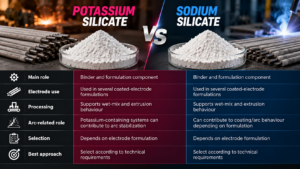
What Should Welding Electrode Manufacturers Check Before Buying the Material?
A purchasing decision should go beyond the product name.
Different formulations may require different chemical and physical characteristics. Important parameters can include:
1. K₂O and SiO₂ Content
The balance between potassium oxide and silica is an important part of silicate chemistry and can influence the characteristics of the material.
2. Molecular or Weight Ratio
The silicate ratio can be relevant when matching the binder to a specific electrode formulation.
3. Moisture
For powdered materials, moisture content can affect handling, storage and formulation consistency.
4. Solubility
A suitable material should behave consistently during preparation of the coating mix.
5. Particle Characteristics
Particle behaviour can influence dissolution, mixing and overall processing.
6. Batch-to-Batch Consistency
Even if an individual batch meets specifications, inconsistent supply can create challenges for large-scale electrode production.
For this reason, manufacturers should review the technical data sheet and quality documentation before finalizing a grade.
Noble Alchem’s Approach to Welding Electrode Grade Material
Noble Alchem manufactures potassium, sodium, lithium and mixed silicates for industrial applications, including welding electrodes. The company states that its silicate products are available in powder, solid and liquid forms and that it supplies customized grades according to customer requirements.
For its welding-electrode-grade potassium silicate powder, Noble Alchem publishes specifications including K₂O, SiO₂, moisture and silicate ratio ranges. The company also identifies welding electrodes as a specific application and offers technical documentation such as TDS and MSDS on request.
For manufacturers, this type of product information is useful because binder selection should be based on the requirements of the actual coating formulation rather than on the material name alone.
Example Technical Specification Reference
The following values represent the published welding-electrode-grade specification from Noble Alchem and should be treated as a product reference rather than a universal industry specification.
| Parameter | Published Range |
| K₂O | 32–35% |
| SiO₂ | 54–58% |
| Weight Ratio | 1.50–1.70 |
| Mole Ratio | 2.35–2.65 |
| Moisture | 9–12% |
| Appearance | White free-flowing powder |
Specifications can vary according to grade and customer requirements, so manufacturers should confirm the current TDS for the specific material being purchased.
Why Consistency Matters More Than Just Purity
A common mistake when selecting industrial raw materials is to look at purity as the only quality indicator.
For electrode manufacturing, consistency can be equally important.
Suppose two batches have similar nominal chemical composition but behave differently during mixing or extrusion. The manufacturer may experience changes in:
- Paste consistency
- Extrusion pressure
- Coating uniformity
- Drying behaviour
- Coating adhesion
- Finished-electrode appearance
This is why a reliable supply program should include documented specifications, quality checks and batch consistency.
For large electrode manufacturers, predictable processing can be just as important as the headline chemical specification.
A Simple Manufacturing Flow
The role of the binder becomes easier to understand when the entire production process is viewed as a chain.
Stage 1 Raw Material Selection
Mineral powders, alloying ingredients and binder are selected according to the electrode formulation.
Stage 2 Dry Mixing
Powdered coating ingredients are blended to achieve a uniform distribution.
Stage 3 Binder Addition
The silicate binder is introduced to create the required wet mixture.
Stage 4 Mixing & Conditioning
The mixture is processed until it reaches suitable consistency for forming.
Stage 5 Extrusion
The coating mass is pressed around the metal core wire.
Stage 6 Drying
Water is removed under controlled conditions and the coating develops its required mechanical structure.
Stage 7 Baking/Conditioning
Where required by the electrode formulation, further heat treatment is carried out.
Stage 8 Quality Inspection
The finished electrodes are checked for coating integrity and other product-specific requirements.
Industrial descriptions of electrode production follow this general relationship between flux preparation, binder addition, extrusion and drying.
Common Problems When the Binder Is Not Properly Selected
Binder selection can influence several stages of production.
Poor Coating Adhesion
If the formulation does not provide adequate bonding, the coating may become fragile or separate from the core.
Difficult Extrusion
An unsuitable wet mix may create inconsistent extrusion behaviour.
Cracking During Drying
Drying conditions and binder characteristics need to work together. Poorly controlled drying can affect coating integrity.
Batch Variability
Changes in raw-material characteristics can create differences in production behaviour from one batch to another.
Inconsistent Finished Electrodes
Ultimately, variations in the coating can affect manufacturing consistency and the expected behaviour of the finished electrode.
These problems are why manufacturers should evaluate the binder as part of the complete electrode formulation rather than as an isolated ingredient.
How to Select a Potassium Silicate Grade for Welding Electrodes
Before purchasing, an electrode manufacturer should ask several practical questions:
- What type of electrode coating is being manufactured?
- What K₂O and SiO₂ ranges are required?
- What molecular or weight ratio fits the formulation?
- What moisture level is acceptable?
- How quickly does the powder dissolve or disperse during mixing?
- Is the material suitable for the existing extrusion process?
- Does the supplier provide a current TDS and MSDS?
- Can the supplier maintain batch-to-batch consistency?
- Are customized specifications available?
- Can the supplier provide samples for production trials?
These questions make the purchasing process more technical and less dependent on price alone.
Frequently Asked Questions
1. Why is potassium silicate powder used in welding electrode manufacturing?
It is primarily used as an inorganic binder in electrode coating formulations. It helps hold mineral and flux ingredients together, supports the formation of a workable coating mixture and contributes to coating integrity after drying. Potassium-containing silicate systems can also contribute to arc-stabilizing behaviour.
2. How does potassium silicate help in welding electrode coating?
During production, it helps bind powdered coating ingredients into a workable mass that can be formed around the metal core. After water is removed during drying, the silicate system develops a hardened inorganic structure that helps maintain coating integrity.
3. When is potassium silicate added during electrode manufacturing?
It is generally incorporated after the dry coating ingredients have been prepared and mixed, before the coating mass is formed or extruded onto the electrode core. The exact mixing sequence and quantity depend on the electrode formulation and production process.
4. What should manufacturers check when buying potassium silicate for electrodes?
Manufacturers should review parameters such as K₂O and SiO₂ content, molecular or weight ratio, moisture, solubility, physical form, batch consistency and compatibility with their coating process. A current technical data sheet and material safety data sheet should also be requested.
5. Is potassium silicate better than sodium silicate for welding electrodes?
There is no universal answer because the appropriate binder depends on the electrode formulation and required performance. Both potassium and sodium silicate systems are used in welding electrode coatings. Potassium-containing systems are particularly relevant where their specific chemistry and arc-related characteristics suit the formulation.
Conclusion
Welding electrode manufacturing depends on precision at every stage, and the coating binder is one of the materials that connects formulation chemistry with production performance.
Potassium silicate can provide the binding and processing characteristics needed to turn a collection of mineral powders into a stable electrode coating. Its role continues through mixing, extrusion and drying, while its potassium-containing chemistry can also contribute to the behaviour of the electrode during welding.
For this reason, manufacturers should evaluate the material based on the complete application rather than choosing a grade solely by price or nominal purity.
For application-specific requirements, Noble Alchem offers potassium silicate powder grades for welding-electrode manufacturing and can discuss customized specifications with industrial buyers.