
A concrete floor can look strong and still have a relatively weak, dusty or porous surface.
This is where lithium silicate densifier comes into the picture.
A densifier is a penetrating treatment designed to react with components in cementitious concrete and improve the characteristics of the surface. It is widely associated with concrete hardening, dust reduction and polished concrete systems.
But there is an important point that is often missed: a densifier is not simply a coating that sits on top of concrete.
Its purpose, application method and expected performance are different from those of many conventional sealers.
So, how does a lithium silicate densifier work? When should it be applied? Why is lithium used instead of other silicates? And what should contractors, flooring professionals and industrial buyers look for before selecting a product?
This guide explains the chemistry, applications, benefits, limitations and practical considerations in detail.
What Is a Lithium Silicate Densifier?
A lithium silicate densifier is a liquid treatment designed to penetrate a suitable concrete surface and react with calcium-containing components within the cementitious matrix.
The reaction contributes to the formation of additional calcium-silicate-hydrate (C-S-H), one of the important binding phases associated with hardened cement paste.
In practical terms, the treatment can help make the near-surface concrete structure:
- Harder
- Denser
- Less prone to surface dusting
- More resistant to everyday abrasion
- Better suited to polishing
The exact result depends on the concrete itself, including its mix design, age, porosity, surface preparation and condition, as well as the formulation and application method of the densifier.
Noble Alchem describes its lithium silicate products as being used for concrete finishing and floor polishing applications, including industrial sheds, warehouses and commercial buildings.
Simple Explanation
Think of concrete as a material containing a network of pores.
A suitable densifier penetrates this surface and participates in chemical reactions within the cementitious material rather than simply creating a thick film over it.
That is why densification and coating should not automatically be treated as the same process.
How Does Lithium Silicate Densifier Work?
The basic mechanism involves penetration followed by chemical reaction.
Concrete contains cementitious compounds, including calcium hydroxide generated during cement hydration. A silicate treatment can react with available calcium-containing material and contribute to the formation of additional C-S-H.
A simplified representation is:
Silicate + calcium-containing components → additional C-S-H structure
C-S-H is important because it contributes significantly to the strength and structure of hardened cement paste.
The practical objective of densification is therefore not simply to leave material on the surface. It is to improve the characteristics of the concrete near the treated surface.
However, the reaction should not be interpreted as a guarantee of a specific hardness increase on every floor.
Concrete is not uniform.
Two floors can respond differently because of differences in:
- Cement content
- Water-cement ratio
- Aggregate
- Age
- Curing
- Porosity
- Surface preparation
- Existing contamination
- Environmental conditions
This is one reason why professional flooring projects should include a test area before full-scale application.
Why Is Lithium Silicate Used for Concrete Densification?
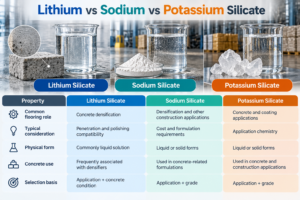
Different soluble silicates can be used in construction-related applications, but lithium-based formulations are commonly associated with concrete densification and polished concrete systems.
Noble Alchem identifies lithium silicate primarily with concrete densification and coatings, while sodium and potassium silicates have broader industrial applications.
The choice of silicate is not just a matter of choosing the most expensive or most concentrated option.
It depends on the intended application and formulation.
A flooring professional may evaluate:
- Penetration
- Reactivity
- Surface condition
- Residue formation
- Polishing requirements
- Application rate
- Drying characteristics
- Compatibility with subsequent treatments
Lithium vs Sodium vs Potassium Silicate
What Are the Main Benefits of a Lithium Concrete Densifier?
When the product is suitable for the concrete and correctly applied, densification can provide several practical benefits.
1. Increased Surface Hardness
A properly selected treatment can improve the hardness characteristics of the concrete surface.
This is particularly useful in environments where floors experience regular traffic, equipment movement and abrasion.
2. Reduced Surface Dusting
Weak or porous concrete can generate dust as loose surface material breaks down.
Densification can reduce this tendency by improving the cohesion and density of the treated surface.
This can be useful in:
- Warehouses
- Manufacturing facilities
- Industrial sheds
- Commercial buildings
- Distribution centres
3. Improved Abrasion Resistance
Industrial floors are exposed to continuous mechanical activity.
Forklifts, pallet movement, foot traffic and equipment can gradually wear a weak surface.
A properly densified floor can provide improved resistance to everyday abrasion, although actual performance depends heavily on the underlying concrete and complete flooring system.
4. Better Polishing Performance
Densifiers are commonly used as part of polished concrete systems.
A harder and more cohesive surface can support the grinding and polishing process and help develop a consistent finish.
Noble Alchem specifically positions its lithium silicate products for concrete finishing and floor polishing applications.
5. Easier Maintenance
A properly finished and densified concrete floor can be relatively straightforward to maintain.
This is particularly valuable for large facilities where cleaning and maintenance costs can accumulate over time.
However, maintenance performance depends on the complete flooring system, traffic conditions and cleaning practices not just the densifier.
Lithium Silicate Densifier vs Lithium Silicate Concrete Sealer
These terms are sometimes used interchangeably in commercial discussions, but they should not automatically be treated as identical.
A densifier primarily works by penetrating the concrete and reacting with cementitious components.
A sealer, depending on its chemistry, is generally intended to provide some form of surface protection, such as resistance to water, staining, chemicals or other contaminants.
Some products can combine multiple functions, but the technical data sheet should always be checked.
Why Does This Difference Matter?
Imagine a warehouse floor where the main problem is surface dusting and low hardness.
A densifier may address that requirement.
Now imagine a floor where the primary concern is chemical staining or water penetration.
A separate compatible protective treatment may be needed.
The treatment should therefore be selected according to the problem you are trying to solve, rather than the product name alone.
When Should Lithium Silicate Densifier Be Applied?
There is no single application time that applies to every lithium silicate product.
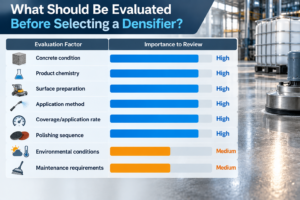
The correct timing depends on:
- Concrete age
- Concrete condition
- Product formulation
- Surface porosity
- Grinding stage
- Polishing system
- Environmental conditions
- Manufacturer instructions
Some products are designed for specific stages of a polished concrete process, while others may have different substrate requirements.
For example, technical guidance from individual manufacturers can specify minimum concrete ages and preferred curing periods. Therefore, the product’s technical data sheet should take priority over a generic internet recommendation.
How to Decide the Timing
Before application, ask:
Is the concrete ready?
Is the surface clean?
Is it porous enough for penetration?
Has the required grinding been completed?
What does the product manufacturer specify?
Will further grinding or polishing follow?
This approach is more reliable than applying the product according to an arbitrary number of days.
How Is Lithium Silicate Densifier Applied?
The exact procedure varies by product, but a typical professional workflow may involve several stages.
Step 1: Inspect the Concrete
Check the slab for:
- Cracks
- Spalling
- Surface contamination
- Existing coatings
- Porosity
- Weak areas
- Moisture-related problems
Step 2: Prepare the Surface
Remove dust, dirt, oil, grease, laitance and incompatible coatings.
If grinding is part of the flooring system, complete the required grinding stage before applying the treatment.
Step 3: Apply the Densifier
Apply the product according to the manufacturer’s recommended coverage and application method.
Depending on the formulation, this can involve spraying, spreading or another controlled method.
Step 4: Maintain Appropriate Contact
Some products require the surface to remain wet for a specified period.
The correct dwell/contact time is product-specific.
Do not assume that leaving every densifier wet for longer will automatically improve performance.
Step 5: Remove Excess Material
If the manufacturer’s instructions require it, remove or work in excess product before it dries.
This can help avoid unwanted residue or surface issues.
Step 6: Continue Grinding and Polishing
Where the treatment is part of a polished concrete system, subsequent grinding and polishing stages should follow the specified sequence.
What Types of Floors Can Use a Lithium Concrete Densifier?
Suitable applications can include many sound cementitious floors where improved surface characteristics are required.
Common environments include:
- Industrial warehouses
- Manufacturing plants
- Commercial buildings
- Corporate facilities
- Distribution centres
- Industrial sheds
- Retail spaces
- Garages
- Polished concrete floors
Noble Alchem identifies industrial sheds, corporate buildings and warehouses among the applications for its flooring silicate products.
But suitability should always be checked.
A densifier is not a universal solution for severely damaged concrete.
When Should You Not Rely on a Densifier Alone?
This is one of the most important points for contractors.
A densifier is not a structural repair product.
If the floor has:
- Major structural cracks
- Severe spalling
- Delamination
- Significant movement
- Deep deterioration
- Major substrate failure
the underlying issue should be evaluated separately.
A densifier cannot turn structurally damaged concrete into a structurally sound slab.
Noble Alchem’s recent guidance similarly distinguishes densification from structural repair and notes that significant damage needs to be addressed separately.
Lithium Silicate Densifier and Polished Concrete
Polished concrete is more than simply making a concrete floor shiny.
The process can involve:
The densifier can play an important role in the overall system by improving surface characteristics before the later polishing stages.
The final appearance, however, depends on much more than the chemical treatment.
It can be influenced by:
- Concrete mix
- Aggregate exposure
- Grinding sequence
- Diamond tooling
- Densifier application
- Polishing sequence
- Final guard/sealer
- Maintenance
This is why a good polished concrete project should be considered as a complete system, not as a single-product application.
Can Potassium Silicate Be Used on Concrete?
Yes, potassium silicate is also used in construction and concrete-related applications.
However, it should not automatically be treated as an identical substitute for a lithium formulation.
Noble Alchem describes lithium, potassium and sodium silicates as materials used across different industrial and construction applications, with lithium silicate particularly associated with concrete densification and coatings.
The correct material depends on:
- Desired performance
- Concrete condition
- Application method
- Formulation
- Cost considerations
- Polishing requirements
- Manufacturer recommendations
How to Choose a Lithium Silicate Densifier
Choosing a product only because it says “lithium silicate” is not enough.
Before purchasing, review the technical documentation.
Check the Chemistry
Look for information such as:
- Active silicate content
- Lithium concentration
- Solids content
- pH
- VOC information
- Recommended dilution
- Coverage
- Storage conditions
Check the Concrete
Ask:
- Is the slab new or existing?
- Is the surface hard or soft?
- Is it porous?
- Has it been ground?
- Is there an existing coating?
- Are there cracks or damaged areas?
- Will the floor be polished?
Check the Application Method
Find out whether the product requires:
- Spraying
- Rolling
- Mechanical distribution
- Specific wet-contact time
- Residue removal
- Special cleaning
Ask for a Trial Area
A small test area can reveal:
- Penetration
- Surface response
- Residue
- Polishing behaviour
- Final appearance
- Coverage
This is particularly useful when working with an unfamiliar concrete mix.
What Affects the Performance of a Polished Concrete Densifier?
The product is only one part of the equation.
Performance can be influenced by:
Concrete Mix
Different cement and aggregate combinations can respond differently.
Porosity
A highly porous floor may absorb material differently from a dense surface.
Surface Preparation
Oil, curing compounds, coatings and dust can interfere with penetration.
Application Rate
Too little material may provide insufficient treatment; excessive application does not automatically improve the result.
Environmental Conditions
Temperature, humidity and airflow can influence application and drying.
Polishing Process
Diamond grit sequence and operator technique have a major influence on final appearance.
Maintenance
Even a well-installed floor requires appropriate cleaning and maintenance.
Why Choose Noble Alchem for Silicate Solutions?
Noble Alchem manufactures and supplies silicate products for several industrial applications.
According to its published company information, its portfolio includes lithium, sodium and potassium silicates, with customized formulations and bulk supply options. Its flooring-focused range includes lithium silicate densifiers for concrete finishing and floor polishing applications.
The company states that it provides silicate solutions for applications including:
- Concrete finishing
- Floor polishing
- Construction
- Welding electrodes
- Coatings
- Oil-well drilling
- Other industrial applications
For an industrial buyer, the useful point is not simply the product range. The important consideration is whether the manufacturer can provide a grade that matches the specific concrete system and application requirements.
Frequently Asked Questions
1. What is a lithium silicate densifier and how does it work?
A lithium silicate densifier is a penetrating treatment designed for suitable cementitious surfaces. It enters the concrete surface and reacts with available calcium-containing components in the cement paste, contributing to the formation of additional C-S-H. This can improve the characteristics of the treated surface, including hardness and resistance to dusting and everyday abrasion. The actual result depends on the concrete, product formulation, surface preparation, application procedure and environmental conditions.
2. What is the difference between a lithium silicate densifier and a lithium silicate concrete sealer?
A densifier and a sealer can have different primary functions.
A densifier is intended to react with the cementitious substrate and improve its surface characteristics. A sealer is generally intended to provide a protective surface function, which can include resistance to water, staining or chemicals depending on the formulation. Some products may combine multiple functions. Therefore, buyers should check the technical data sheet rather than assuming that every product described as a “lithium silicate concrete sealer” performs exactly like a dedicated densifier.
3. When should lithium concrete densifier be applied?
The correct timing depends on the product and flooring system.
Factors include the age and condition of the concrete, surface porosity, grinding stage, environmental conditions and the manufacturer’s instructions. For polished concrete, densification is often incorporated into the grinding and polishing sequence. However, the exact stage should be determined from the product’s technical documentation and the requirements of the flooring system. A small test area can help confirm whether the surface is ready and how it responds to the treatment.